Hexagram 63 · 既濟 · jì jì
Hexagram 63. Jì Jì · After Completion
☵☲ Water over fire: Kǎn above, Lí below.
Ki 3 i intimates progress and success in small matters. There will be advantage in being firm
Ki 3 i intimates progress and success in small matters. There will be advantage in being firm
All is accomplished: every line in its proper place, the crossing complete. But perfect order is the most unstable of states: any motion out of it leads toward disorder. Do not relax at the summit: everything now depends on details, maintenance, prevention. Think of trouble before it arrives.
The Image
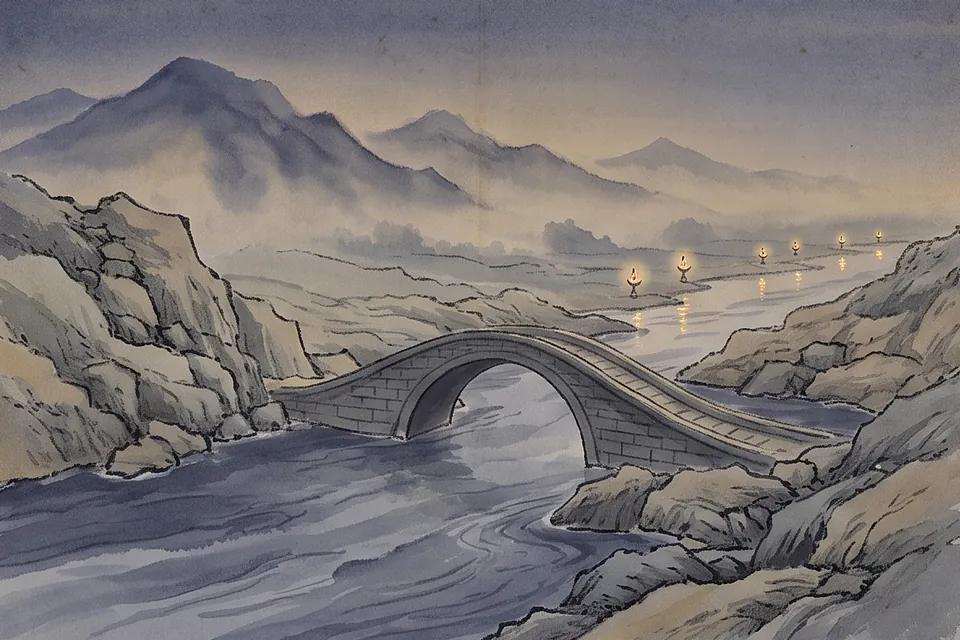
Water above fire: the kettle on the hearth — everything in place, the crossing accomplished. Perfect order is the most unstable of states: any drift from it leads downward. Switch regime from conquest to maintenance: prevention, small repairs, attention to detail, 'the patch kept ready'. Think of trouble while there is none — that is the art of after-completion.
Interpretation of hexagram 63
LXIII. The Ki 3 t Hexagram. had in his mind our distinction of essentials and non-essentials. Is it ever good to deviate from what is recognised as the established course of procedure? The reply is—never in the matter of right; but in what is conventional and ceremonial—in what is non- essential—the deviation may be made, and will be productive of good. The form may be given up, but not the substance. But the thing must be done very carefully,—humbly and reverently, and in small matters.
The lines of hexagram 63
First line
The first line, undivided, (shows its subject as a driver) who drags back his wheel, (or as a fox) which has wet his tail. There will be no error.
The symbolism of the bird is rather obscure. The whole of it is intended to teach humility. It is better for the bird to descend, keeping near to where it can perch and rest, than to hold on ascending into the homeless regions of the air.
Second line
The second line, divided, (shows its subject as) a wife who has lost her (carriage-)screen. There is no occasion to go in pursuit of it. In seven days she will find it.
Line i is weak, in an odd place, and possessed by the ‘ idea of exceeding,’ which belongs to the hexagram. Its correlate is the strong 4, belonging to the trigram K an, the attribute of which is movement. There is nothing to repress the tendency of i; rather it is stimulated ; and hence the symbolism.
Third line
The third line, undivided, (suggests the case of) Kao 3 ung who attacked the Demon region, but was three years in subduing it. Small men should not be employed (in such enterprises).
Line 2 is weak, but in its proper place, and in the centre. Its correlate is 5, which is also a weak line. The lines 3 and 4 between them are both strong; and are supposed to represent the father and grandfather of the subject of 2 ; but he or she goes past them, and meets with the grandmother in 5. Again, 5 is the ruler’s seat. The subject of 2 moves on to him, but not as an enemy; but humbly and loyally, as his minister according to the attributes of a weak line in the central place. It must be allowed that this view of the symbolism and its interpretation is obscure and strained.
Fourth line
The fourth line, divided, shows its subject with rags provided against any leak (in his boat), and on his guard all day long.
The subject of line 3 is too confident in his own strength, and too defiant of the weak and small enemies that seek his hurt.
Fifth line
The fifth line, undivided, shows its subject (as) the neighbour in the east who slaughters an ox (for his sacrifice); but this is not equal to the (small) spring sacrifice of the neighbour in the west, whose sincerity receives the blessing.
THE K1 3l HEXAGRAM.
Top line
The topmost line, divided, shows its subject with (even) his head immersed. The position is perilous.
and correct. There has been good fortune in the beginning; there may be disorder in the end.
Did hexagram 63 come up in your reading? The oracle itself gives the full reading, with changing lines and the second hexagram.
Cast the coins