Hexagram 5 · 需 · xū
Hexagram 5. Xū · Waiting
☵☰ Water over heaven: Kǎn above, Qián below.
Hsu intimates that, with the sincerity which is declared in it, there will be brilliant success. With firmness there will be good fortune; and it will be advantageous to cross the great stream.
Hsu intimates that, with the sincerity which is declared in it, there will be brilliant success. With firmness there will be good fortune; and it will be advantageous to cross the great stream.
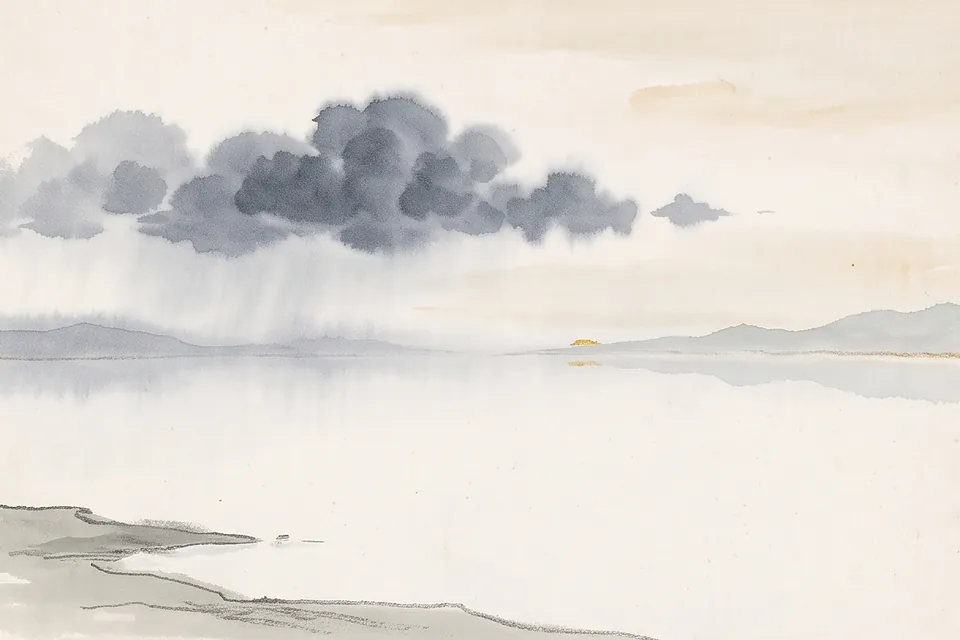
Danger lies ahead but has not yet arrived. Wait not as a captive but as master of the situation: confident, gathering strength. The rain will fall of itself — clouds cannot be dragged across the sky. When the time ripens, the great crossing will succeed.
The Image
Clouds have risen to heaven, but the rain has not yet fallen. Between readiness and realization lies a pause no act of will can shorten. Waiting here is an active stance: strengthen health and resources, keep your connections, eat and drink in peace. Whoever waits with inner certainty stands strongest on the field when the clouds break.
Interpretation of hexagram 5
V. The Hsu Hexagram. If he receive them respectfully, there will be good fortune in the end.
The lines of hexagram 5
First line
The first line, undivided, shows its subject waiting in the distant border. It will be well for him constantly to maintain (the purpose thus shown), in which case there will be no error.
V. Hsii means waiting. Strength confronted by peril might be expected to advance boldly and at once to struggle with it; but it takes the wiser plan of waiting till success is sure. This is the lesson of the hexagram. That ‘ sincerity is declared in it’ is proved from the fifth line in the position of honour and authority, central, itself undivided and in an odd place. In such a case, nothing but firm correctness is necessary to great success.
Second line
The second line, undivided, shows its subject waiting on the sand (of the mountain stream). He will (suffer) the small (injury of) being spoken (against), but in the end there will be good fortune.
‘ Going through a great stream,’ an expression frequent in the Yi, may mean undertaking hazardous enterprises, or encountering great difficulties, without any special reference; but more natural is it to understand by‘the great stream’ the Yellow river, which the lords of /sTau must cross in a revolutionary movement against the dynasty of Yin and its tyrant. The passage of it by king Wfi, the son of Wan in b.c. 1122, was certainly one of the greatest deeds in the history of China. It was preceded also by long ‘ waiting,’ till the time of assured success came.
Third line
The third line, undivided, shows its subject in the mud (close by the stream). He thereby invites the approach of injury.
‘ The border ’ under line 1 means the frontier territory of the state. There seems no necessity for such a symbolism. ‘The sand’ and ‘ the mud ’ are appropriate with reference to the watery defile; but it is different with ‘the border.’ The subject of the line appears at work in his distant fields, not thinking of anything but his daily work; and he is advised to abide in that state and mind.
Fourth line
The fourth line, divided, shows its subject waiting in (the place of) blood. But he will get out of the cavern.
‘ The sand ’ of paragraph 2 suggests a nearer approach to the defile, but its subject is still self-restrained and waiting. I do not see what suggests the idea of his suffering from ‘ the strife of tongues.’
Fifth line
The fifth line, undivided, shows its subject waiting amidst the appliances of a feast. Through his firmness and correctness there will be good fortune.
In paragraph 3 the subject is on the brink of the stream. His advance to that position has provoked resistance, which may result in his injury.
Top line
The topmost line, divided, shows its subject entered into the cavern. (But) there are three guests coming, without being urged, (to his help).
Line 4 has passed from the inner to the upper trigram, and entered on the scene of danger and strife;—‘into the place of blood.’ Its subject is ‘weak and in the correct place for him;’ he therefore retreats and escapes from the cavern, where he was engaged with his enemy.
Did hexagram 5 come up in your reading? The oracle itself gives the full reading, with changing lines and the second hexagram.
Cast the coins