Hexagram 13 · 同人 · tóng rén
Hexagram 13. Tóng Rén · Fellowship
☰☲ Heaven over fire: Qián above, Lí below.
Thung Zan (or ‘Union of men’) appears here (as we find it) in the (remote districts of the) country, indicating progress and success. It will be advan¬ tageous to cross the great stream. It will be ad¬ vantageous to maintain the firm correctness of the superior man.
Thung Zan (or ‘Union of men’) appears here (as we find it) in the (remote districts of the) country, indicating progress and success. It will be advan¬ tageous to cross the great stream. It will be ad¬ vantageous to maintain the firm correctness of the superior man.
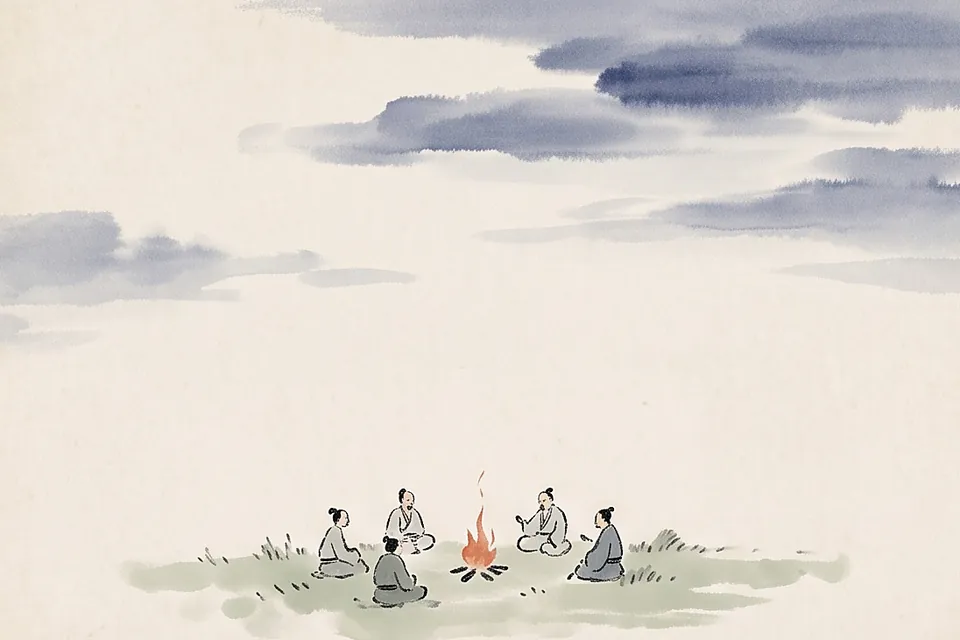
Union with the like-minded — not in a closed circle of one's own, but in the open field, around a common cause. Such an alliance, founded on a clear aim rather than clan interest, is capable of the great crossing. Openness and shared purpose are the condition of success.
The Image
Fire rises toward heaven: things different in nature strive toward one point. A time for unions around a cause, not around kinship and sympathy: an open aim, transparent rules, allies beyond the habitual circle. The test of a union is simple: it must bear the light. Whatever needs closed doors and inside people is no longer fellowship but a clique.
Interpretation of hexagram 13
XIII. The Thung ZAn Hexagram. SECT. I. THE THUNG zXn HEXAGRAM. 87
The lines of hexagram 13
First line
The first line, undivided, (shows the repre¬ sentative of) the union of men just issuing from his gate. There will be no error.
sentative of) the union of men in the suburbs. There will be no occasion for repentance.
Second line
The second line, divided, (shows the repre¬ sentative of) the union of men in relation with his kindred. There will be occasion for regret.
XIII. Thung Zan describes a condition of nature and of the state opposite to that of Phi. There was distress and obstruction; here is union. But the union must be based entirely on public considerations, without taint of selfishness.
Third line
The third line, undivided, (shows its subject) with his arms hidden in the thick grass, and at the top of a high mound. (But) for three years he makes no demonstration.
The strong line in the fifth, its correct, place, occupies the most important position, and has for its correlate the weak second line, also in its correct place. The one divided line is naturally sought after by all the strong lines. The upper trigram is that of heaven, which is above; the lower is that of fire, whose tendency is to mount upwards. All these things are in harmony with the idea of union. But the union must be free from all selfish motives, and this is indicated by its being in the remote districts of the country, where people are unsophisticated, and free from the depraving effects incident to large societies. A union from such motives will cope with the greatest difficulties; and yet a word of caution is added.
Fourth line
The fourth line, undivided, (shows its subject) mounted on the city wall; but he does not proceed to make the attack (he contemplates). There will be good fortune.
Line 1 emblems the first attempts at union. It is strong, but in the lowest place; and it has no proper correlate above. There is, however, no intermixture of selfishness in it.
Fifth line
In the fifth line, undivided, (the representative of) the union of men first wails and cries out, and then laughs. His great host conquers, and he (and the subject of the second line) meet together.
Lines 2 and 5 are proper correlates, which fact suggests in this hexagram the idea of their union being limited and partial, and such as may afford ground for blame.
Top line
The topmost line, undivided, (shows the repre-
Line 3 is strong, and in an odd place; but it has not a proper cor¬ relate in 6. This makes its subject more anxious to unite with 2 ; but 2 is devoted to its proper correlate in 5, of whose strength 3 is afraid, and takes the measures described. His abstaining so long, however, from any active attempt, will save him from misfortune.
Did hexagram 13 come up in your reading? The oracle itself gives the full reading, with changing lines and the second hexagram.
Cast the coins