Hexagram 3 · 屯 · zhūn
Hexagram 3. Zhūn · Difficulty at the Beginning
☵☳ Water over thunder: Kǎn above, Zhèn below.
Kww (Indicates that in the case which it pre¬ supposes) there will be great progress and success, and the advantage will come from being correct and firm. (But) any movement in advance should not be (lightly) undertaken. There will be advantage in appointing feudal princes.
Kww (Indicates that in the case which it pre¬ supposes) there will be great progress and success, and the advantage will come from being correct and firm. (But) any movement in advance should not be (lightly) undertaken. There will be advantage in appointing feudal princes.
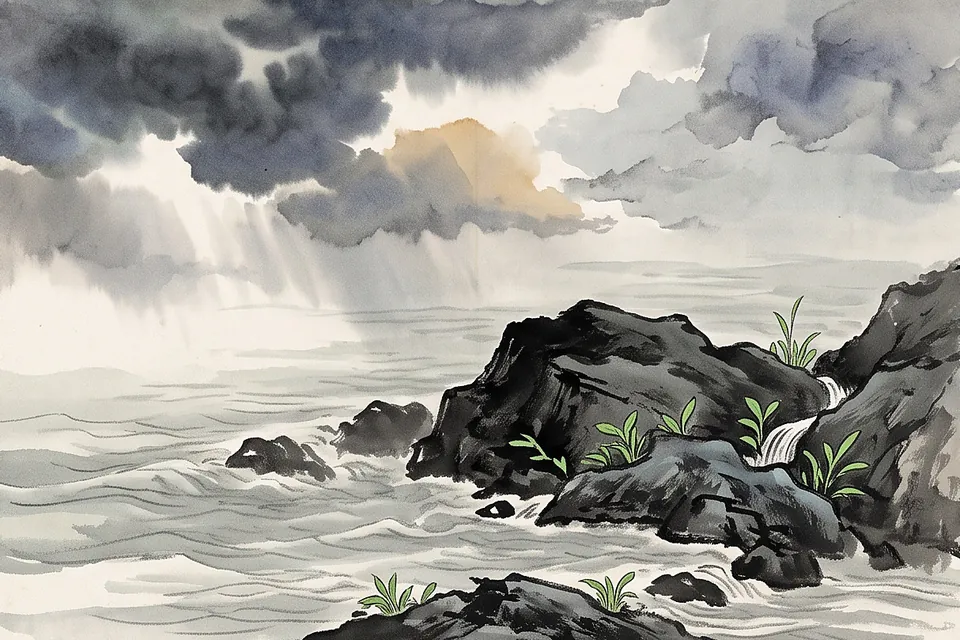
A sprout pushes through frozen ground: the design is alive, but every birth is hard. The chaos of beginnings is no reason to retreat — it is a call to bring order. Do not act alone and do not force events: find allies and patiently untangle the threads.
The Image
Thunder beneath the clouds: energy presses upward into a dense medium. Every true beginning passes through this stage — the chaos of details, too few hands, the material's resistance. The mistake is to read it as a verdict, or to force through. The right course: structure the small, find helpers, give the sprout time. Initial difficulty signals vitality, not doom.
Interpretation of hexagram 3
III. The ,/sTun Hexagram. dragon, and fights with the true dragon, the subject of the undivided line. They fight and bleed, and their blood is of the colour proper to heaven or the sky, and the colour proper to the earth. Paragraph 7 supposes that the hexagram Khwan should become changed into Kh'xtn ;—the result of which would be good.
The lines of hexagram 3
First line
The first line, undivided, shows the difficulty (its subject has) in advancing. It will be advanta¬ geous for him to abide correct and firm; advan¬ tageous (also) to be made a feudal ruler.
THE £TUN HEXAGRAM.
Second line
The second line, divided, shows (its subject) distressed and obliged to return; (even) the horses of her chariot (also) seem to be retreating. (But) not by a spoiler (is she assailed), but by one who seeks her to be his wife. The young lady maintains her firm correctness, and declines a union. After ten years she will be united, and have children.
III. The character called Wun is pictorial, and was intended to show us how a plant struggles with difficulty out of the earth, rising gradually above the surface. This difficulty, marking the first stages in the growth of a plant, is used to symbolise the struggles that mark the rise of a state out of a condition of disorder, consequent on a great revolution. The same thing is denoted by the combination of the trigrams that form the figure;—as will be seen in the notes on it under Appendix II.
Third line
The third line, divided, shows one following the deer without (the guidance of) the forester, and only finding himself in the midst of the forest. The superior man, acquainted with the secret risks, thinks it better to give up the chase. If he went forward, he would regret it.
I have introduced within parentheses, in the translation, the words * in the case which the hexagram presupposes.’ It is necessary to introduce them. King Wan and his son wrote, as they did in every hexagram, with reference to a particular state of affairs which they had in mind. This was the unspoken text which controlled and directed all their writing; and the student must try to get hold of this, if he would make his way with comfort and success through the Yi. Wan saw the social and political world around him in great disorder, hard to be remedied. But he had faith in himself and the destinies of his House. Let there be prudence and caution, with unswerving adherence to the right; let the government of the different states be entrusted to good and able men:—then all would be well.
Fourth line
The fourth line, divided, shows (its subject as a lady), the horses of whose chariot appear in retreat. She seeks, however, (the help of) him who seeks her to be his wife. Advance will be fortu¬ nate ; all will turn out advantageously.
The first line is undivided, showing the strength of its subject. He will be capable of action, and his place in the trigram of mobility will the more dispose him to it. But above him is the
Fifth line
The fifth line, undivided, shows the difficulties in the way of (its subject’s) dispensing the rich favours that might be expected from him. With firm¬ ness and correctness there will be good fortune in small things; (even) with them in great things there will be evil.
Top line
The topmost line, divided, shows (its subject) with the horses of his chariot obliged to retreat, and weeping tears of blood in streams.
Did hexagram 3 come up in your reading? The oracle itself gives the full reading, with changing lines and the second hexagram.
Cast the coins