Hexagram 29 · 坎 · kǎn
Hexagram 29. Kǎn · The Abysmal
☵☵ Water over water: Kǎn above, Kǎn below.
Khan, here repeated, shows the possession of sincerity, through which the mind is penetrating. Action (in accordance with this) will be of high value.
Khan, here repeated, shows the possession of sincerity, through which the mind is penetrating. Action (in accordance with this) will be of high value.
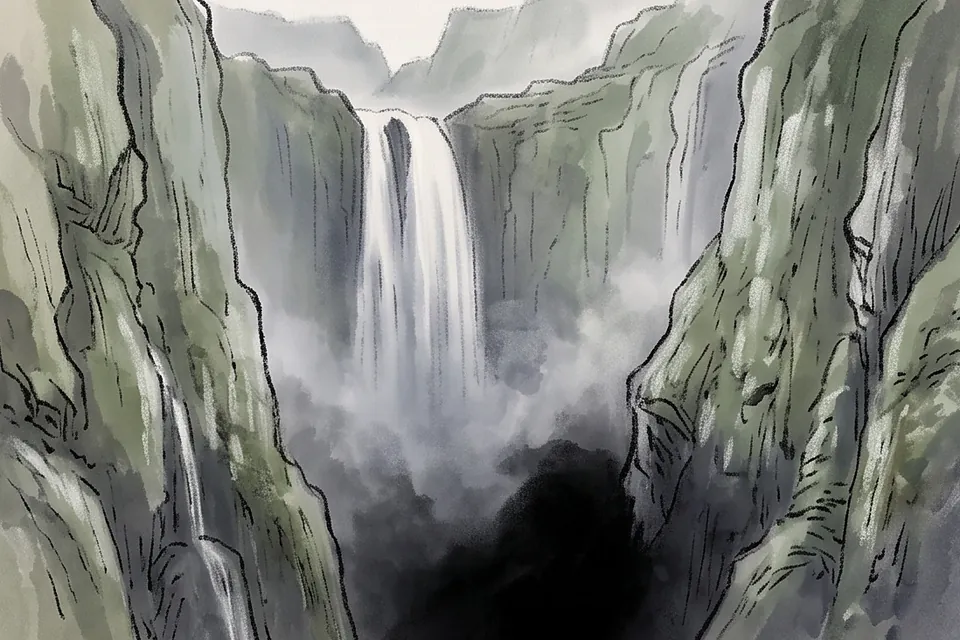
Danger doubled: chasm upon chasm. What saves is not force but water's faithfulness to itself — it flows on, fills every hollow, and never betrays its nature. Hold to the core — truth in the heart, practiced skill — and keep moving; do not settle at the bottom.
The Image
Water upon water: danger repeating in series. From such a stretch no single leap escapes — what saves is water's fidelity to its own nature: it tries to be nothing else, fills every hollow, and flows on. Hold the core — professional skill, inner truth, the near circle — and pass the dangers one at a time, never settling at the bottom.
Interpretation of hexagram 29
XXIX. The Khan Hexagram. old husband with a young wife will yet have children; the action of the subject of 2 will be successful.
The lines of hexagram 29
First line
The first line, divided, shows its subject in the double defile, and (yet) entering a cavern within it. There will be evil.
Line 3 is strong, and in an odd place. Its subject is confident in his own strength, but his correlate in 6 is weak. Alone, he is unequal to the extraordinary strain on him, and has for his symbol the weak beam.
Second line
The second line, undivided, shows its subject
Line 4 is near 5, the ruler’s place. On its subject devolves the duty of meeting the extraordinary exigency of the time; but he is strong; and, the line being in an even place, his strength is tem¬ pered. He will be equal to his task. Should he look out for the help of the subject of 1, that would affect him with another element of weakness ; and his action would give cause for regret.
Third line
The third line, divided, shows its subject, whether he comes or goes ( = descends or ascends), confronted by a defile. All is peril to him and unrest. (His endeavours) will lead him into the cavern of the pit. There should be no action (in such a case).
Line 5 is strong and central. Its subject should be equal to achieve extraordinary merit. But he has no proper correlate below, and as 2 inclined to 1, so does this to 6. But here the willow only produces flowers, not shoots;—its decay will soon reappear. An old wife will have no children. If the subject of the line is not to be condemned as that of 3, his action does not deserve praise.
Fourth line
The fourth line, divided, shows its subject (at a feast), with (simply) a bottle of spirits, and a sub¬ sidiary basket of rice, while (the cups and bowls) are (only) of earthenware. He introduces his im¬ portant lessons (as his ruler’s) intelligence admits. There will in the end be no error.
The subject of 6 pursues his daring course, with a view to satisfy the extraordinary exigency of the time, and benefit all under the sky. He is unequal to the task, and sinks beneath it; but his motive modifies the judgment on his conduct.
Fifth line
The fifth line, undivided, shows the water of the defile not yet full, (so that it might flow away); but order will (soon) be brought about. There will be no error.
THE KHAN HEXAGRAM.
Top line
The topmost line, divided, shows its subject bound with cords of three strands or two strands, and placed in the thicket of thorns. But in three years he does not learn the course for him to pursue. There will be evil.
in all the peril of the defile. He will, however, get a little (of the deliverance) that he seeks.
Did hexagram 29 come up in your reading? The oracle itself gives the full reading, with changing lines and the second hexagram.
Cast the coins