Hexagram 62 · 小過 · xiǎo guò
Hexagram 62. Xiǎo Guò · Preponderance of the Small
☳☶ Thunder over mountain: Zhèn above, Gèn below.
HsiAo Kwo indicates that (in the circumstances which it implies) there will be progress and attain-
HsiAo Kwo indicates that (in the circumstances which it implies) there will be progress and attain-
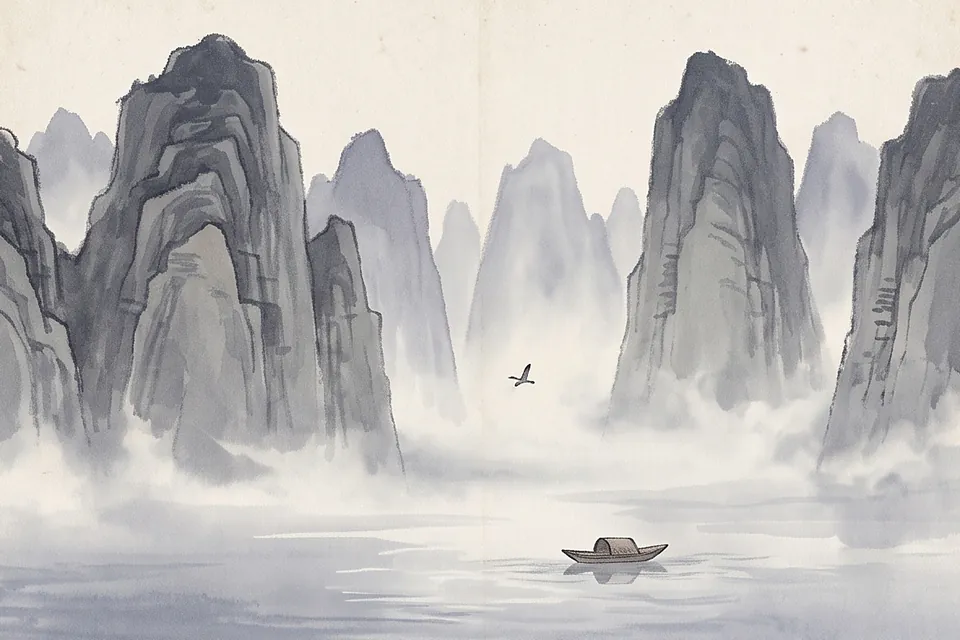
The bird must not fly above its nest: a time for scrupulousness in the small and renunciation of the great. Be exaggeratedly modest, exaggeratedly attentive to detail, exaggeratedly thrifty. Whoever reaches upward now loses; whoever descends and does the small impeccably, gains.
The Image
Thunder above the mountain sounds muffled: a time when the great is oversized and the small fits exactly. The strategy of humble scrupulousness: care in trifles, exaggerated courtesy, thrift, promises understated rather than overstated. The bird of this season should not fly above its nest: the modest roundabout way is safer than the ceremonial one, and precision counts more than sweep.
Interpretation of hexagram 62
LXII. The Hsiao Kwo Hexagram. subject of the ‘Doctrine of the Mean’ from the 21st chapter onwards, where Remusat rendered it by ‘la perfection,’‘la perfection morale,’ and Intorcetta and his coadjutors by ‘vera solidaque perfectio.’ The lineal figure has suggested to the Chinese com¬ mentators, from the author of the first Appendix, two ideas in it which deserve to be pointed out. There are two divided lines in the centre and two undivided below them and above them. The divided lines in the centre are held to represent the heart or mind free from all pre-occupation, without any consciousness of self; and the undivided lines, on each side of it, in the centre of the con¬ stituent trigrams are held to denote the solidity of the virtue of one so free from selfishness. There is no unreality in it, not a single flaw.
The lines of hexagram 62
First line
The first line, divided, suggests (the idea of) a bird flying, (and ascending) till the issue is evil.
The ‘ Daily Lecture ’ at the conclusion of its paraphrase of the Thwan refers to the history of the ancient Shun, and the wonder¬ ful achievements of his virtue. The authors give no instance of the affecting of ‘ pigs and fishes ’ by sincerity, and say that these names are symbolical of men, the rudest and most unsusceptible of being acted on. The Text says that the man thus gifted with sin¬ cerity will succeed in the most difficult enterprises. Remarkable is the concluding sentence that he must be firm and correct. Here, as elsewhere throughout the Yi, there comes out the practical character which has distinguished the Chinese people and their best teaching all along the line of history.
Second line
The second line, divided, shows its subject passing by his grandfather, and meeting with his
The translation of paragraph 1 is according to the view approved by the Khang-hsi editors. The ordinary view makes the other to whom the subject of line 1 looks or might look to be the subject of 4; but they contend that, excepting in the case of 3 and 6, the force of correlation should be discarded from the study of this
Third line
The third line, undivided, shows its subject taking no extraordinary precautions against danger; and some in consequence finding opportunity to assail and injure him. There will be evil.
ment. But it will be advantageous to be firm and correct. (What the name denotes) may be done in small affairs, but not in great affairs. (It is like) the notes that come down from a bird on the wing ;—to descend is better than to ascend. There will (in this way) be great good fortune.
Fourth line
The fourth line, undivided, shows its subject falling into no error, but meeting (the exigency of his situation), without exceeding (in his natural course). If he go forward, there will be peril, and he must be cautious. There is no occasion to be using firmness perpetually.
hexagram; for the virtue of sincerity is all centred in itself, thence derived and thereby powerful.
Fifth line
The fifth line, c ivided, (suggests the idea) of dense clouds, but no rain, coming from our borders in the west. It also (shows) the prince shooting his arrow, and taking the bird in a cave.
For paragraph 2, see Appendix III, Section i, 42. It is in rhyme, and I have there rendered it in rhyme. The ‘ young ones of the crane’ are represented by line 1. In the third and fourth sentences we have the symbolism of two men brought together by their sympathy in virtue. The subject of the paragraph is the effect of sincerity.
Top line
The sixth line, divided, shows its subject not meeting (the exigency of his situation), and ex¬ ceeding (his proper course). (It suggests the idea of) a bird flying far aloft. There will be evil. The case is what is called one of calamity and self- produced injury.
The ‘ mate ’ of line 3 is 6. The principle of correlation comes in. Sincerity, not left to itself, is influenced from without, and hence come the changes and uncertainty in the state and moods of the subject of the line.
Did hexagram 62 come up in your reading? The oracle itself gives the full reading, with changing lines and the second hexagram.
Cast the coins