Hexagram 22 · 賁 · bì
Hexagram 22. Bì · Grace
☶☲ Mountain over fire: Gèn above, Lí below.
Pi indicates that there should be free course (in what it denotes). There will be little advantage (however) if it be allowed to advance (and take the lead).
Pi indicates that there should be free course (in what it denotes). There will be little advantage (however) if it be allowed to advance (and take the lead).
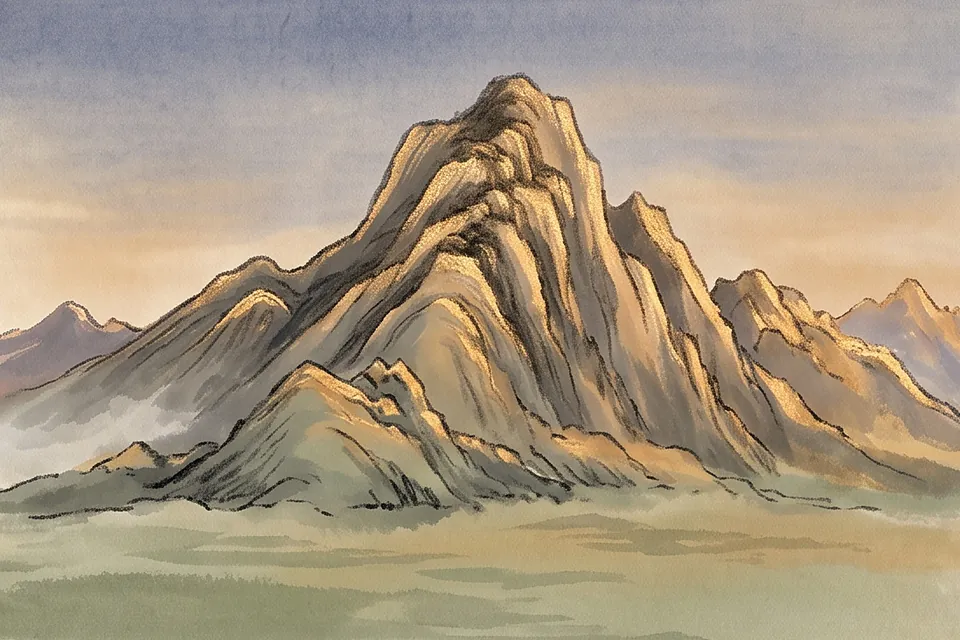
Fire at the mountain's foot lights its slopes: beauty of form, finish, elegance. Adornment belongs to the small — style, manners, presentation; great questions are not settled by it. Polish the surface without replacing the substance: form serves content, never the reverse.
The Image
Fire lights the mountain from below: beauty as the illumination of substance. A time to work on form — style, presentation, interface, manners. Form matters: it lets content reach its addressee. But questions of substance cannot be settled by form: where repair is needed, cosmetics deceive. The highest grace is a simplicity that needs nothing more.
Interpretation of hexagram 22
XXII. The Pi Hexagram. be effective; and this is shown by the ‘ biting through the soft flesh,’ an easy thing. Immediately below, however, is a strong offender represented by the strong line, and before he will submit it is necessary to 1 bite off his nosefor punishment is the rule ;— it must be continued and increased till the end is secured.
The lines of hexagram 22
First line
The first line, undivided, shows one adorning (the way of) his feet. He can discard a carriage and walk on foot.
Line 3 is weak, and in an even place. The action of its subject will be ineffective; and is emblemed by the hard task of gnawing through dried flesh, and encountering, besides, what is distasteful and injurious in it. But again comes in the consideration that here punishment is the rule, and the auspice is not all bad.
Second line
The second line, divided, shows one adorning his beard.
Of old, in a civil case, both parties, before they were heard, brought to the court an arrow (or a bundle of arrows), in testimony of their rectitude, after which they were heard ; in a criminal case, they in the same way deposited each thirty pounds of gold, or some other metal. See the Official Book of Kwt, 27. 14, 15. The subject of the fourth line’s getting those pledges indicates his exercising his judicial functions; and what he gnaws through indi¬ cates their difficulty. Moreover, though the line is strong, it is in an even place; and hence comes the lesson of caution.
Third line
The third line, undivided, shows its subject with the appearance of being adorned and bedewed (with rich favours). But let him ever maintain his firm correctness, and there will be good fortune.
The fifth line represents ‘ the lord of judgment.’ As it is a weak line, he will be disposed to leniency; and his judgments will be correct. This is declared by his finding the ‘yellow metal;’ for yellow is one of the five ‘correct’ colours. The position is in the centre and that of rule; but the line being weak, a caution is given, as under the previous line.
Fourth line
The fourth line, divided, shows one looking as if adorned, but only in white. As if (mounted on) a white horse, and furnished with wings, (he seeks union with the subject of the first line), while (the intervening third pursues), not as a robber, but in¬ tent on a matrimonial alliance.
The action of the figure has passed, and still we have, in the sub¬ ject of line 6, one persisting in wrong, a strong criminal, wearing the cangue, and deaf to counsel. Of course the ausp ; ce is evil.
Fifth line
The fifth line, divided, shows its subject adorned by (the occupants of) the heights and gar¬ dens. He bears his roll of silk, small and slight. He may appear stingy; but there will be good fortune in the end.
XXII. The character Pi is the symbol of what is ornamental and of the act of adorning. As there is ornament in nature, so should there be in society; but its place is secondary to that of what is substantial. This is the view of king Wan in his Thwan. The symbolism of the separate lines is sometimes fantastic.
Top line
The sixth line, undivided, shows one with white as his (only) ornament. There will be no error.
Line 1 is strong, and in an odd place. It is at the very bottom of the hexagram, and is the first line of LI, the trigram for fire or light, and suggesting what is elegant and bright. Its subject has nothing to do but to attend to himself. Thus he cultivates— adorns—himself in his humble position; but if need be, righteous¬ ness requiring it, he can give up every luxury and indulgence.
Did hexagram 22 come up in your reading? The oracle itself gives the full reading, with changing lines and the second hexagram.
Cast the coins