Hexagram 36 · 明夷 · míng yí
Hexagram 36. Míng Yí · Darkening of the Light
☷☲ Earth over fire: Kūn above, Lí below.
Ming t indicates that (in the circumstances which it denotes) it will be advantageous to realise the
Ming t indicates that (in the circumstances which it denotes) it will be advantageous to realise the
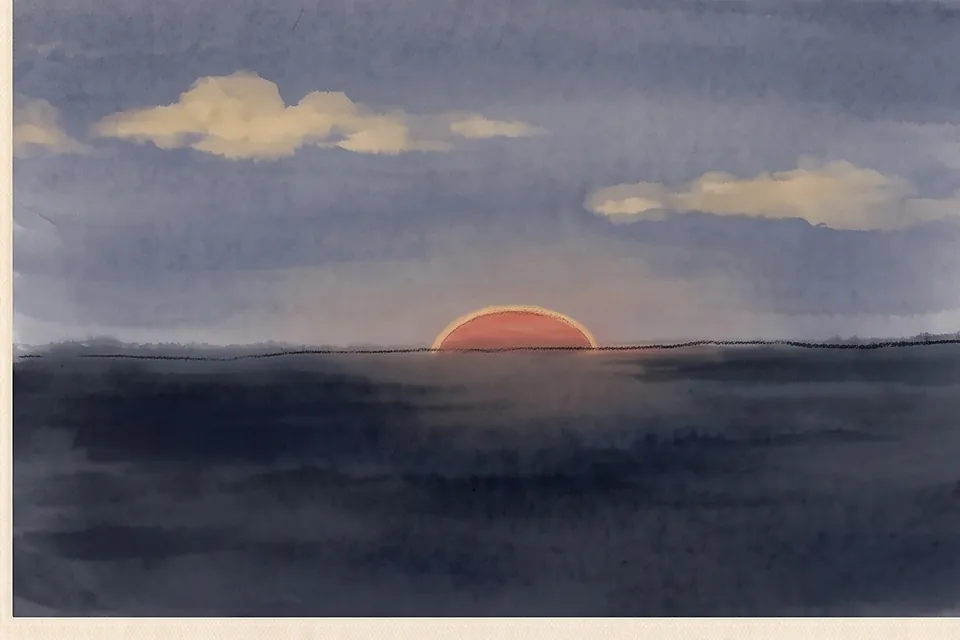
The light has sunk beneath the earth: a time when intellect and dignity must be veiled. Do not fight the darkness in the open — it is stronger on its own ground. Be outwardly yielding, inwardly unbending; shine inward like a hidden flame, and outlast the eclipse.
The Image
The light has gone beneath the earth: a period when clarity and dignity must be concealed. Open confrontation with darkness on its own field is a losing game. The tactic: outward compliance, inward inflexibility; work quietly, keep the light for your own. Prince Ji's story says a dark age can be survived without joining it and without going out.
Interpretation of hexagram 36
XXXVI. The Ming ! Hexagram. the great blessing. The ‘ New Digest of Comments on the Yi (1686),’ in its paraphrase of the line, has, * He receives at last this great blessing from the mild and compliant ruler.’ I am not sure that ‘ motherly king ’ would not be the best and fairest translation of the phrase.
The lines of hexagram 36
First line
The first line, undivided, shows its subject, (in the condition indicated by) Ming I, flying, but with drooping wings. When the superior man (is re¬ volving) his going away, he may be for three days without eating. Wherever he goes, the people there may speak (derisively of him).
Canon McClatchie has a very astonishing note on the name, which he renders ‘Imperial Mother’ (p. 164):—‘That is, the wife of Imperial Heaven (Juno), who occupies the “ throne of the dia¬ gram,” viz. the fifth stroke, which is soft and therefore feminine. She is the Great Ancestress of the human race. See Imp. Ed. vol. iv, Sect, v, p. 23, Com.’ Why such additions to the written word ?
Second line
The second line, divided, shows its subject, (in the condition indicated by) Ming !, wounded in the left thigh. He saves himself by the strength of a (swift) horse ; and is fortunate.
Line 3 is weak, and in an odd place; but the subjects of 1 and 2 are possessed by the same desire to advance as the subject of this. A common trust and aim possess them ; and hence the not unfavourable auspice.
Third line
The third line, undivided, shows its subject, (in the condition indicated by) Ming !, hunting in the south, and taking the great chief (of the dark¬ ness). He should not be eager to make (all) correct (at once).
Line 4 is strong, but it is in an even place, nor is it central. It suggests the idea of a marmot (? or rat), stealthily advancing. Nothing could be more opposed to the ideal of the feudal lord in the hexagram.
Fourth line
The fourth line, divided, shows its subject (just) entered into the left side of the belly (of the dark land). (But) he is able to carry out the mind appro¬ priate (in the condition indicated by) Ming I, quitting the gate and courtyard (of the lord of darkness).
In line 5 that lord and his intelligent sovereign meet happily. He holds on his right course, indifferent as to results, but things are so ordered that he is, and will continue to be, crowned with success.
Fifth line
The fifth line, divided, shows how the count of Ki fulfilled the condition indicated by Ming t. It will be advantageous to be firm and correct.
Line 6 is strong, and suggests the idea of its subject to the last continuing his advance, and that not only with firm correctness, but with strong force. The ‘ horns’ are an emblem of threatening strength, and though he uses them only in his own state, and against the rebellious there, that such a prince should have any occasion to use force is matter for regret.
Top line
The sixth line, divided, shows the case where there is no light, but (only) obscurity. (Its subject) had at first ascended to (the top of) the sky; his future shall be to go into the earth.
THE MING I HEXAGRAM.
Did hexagram 36 come up in your reading? The oracle itself gives the full reading, with changing lines and the second hexagram.
Cast the coins