Hexagram 47 · 困 · kùn
Hexagram 47. Kùn · Oppression
☱☵ Lake over water: Duì above, Kǎn below.
In (the condition denoted by) Khwan there may (yet be) progress and success. For the firm and
In (the condition denoted by) Khwan there may (yet be) progress and success. For the firm and
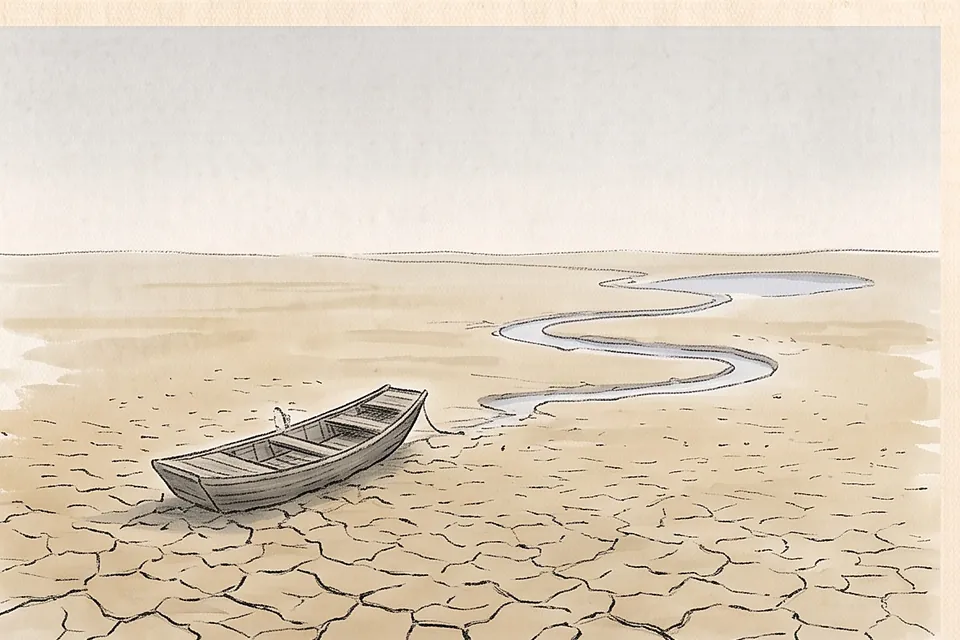
A lake drained of water: strength and means are exhausted, words carry no weight — explaining and persuading are useless now. Yet exhaustion is precisely where the great man is proved: he wastes no remaining strength on complaint, but keeps faith with his aim. Hold on quietly and firmly — there is a way out of oppression.
The Image
A lake from beneath which the water has drained: resources spent, words devalued — you are simply not believed now. Waste no remaining strength on justification and persuasion: in this phase only actions and endurance prove anything. Contract to the core, hold the aim, accept small tokens of support. Oppression is the examination for greatness; it is passed in silence.
Interpretation of hexagram 47
XLVII. The Khwan Hexagram. hexagram, it shows him to be possessed of modesty and force. Then the ruler’s seat, the fifth place, is occupied by a divided line, indi¬ cating that he will welcome the advance of 2. The officer therefore both has the qualities that fit him to advance, and a favourable opportunity to do so. The result of his advance will be fortunate.
The lines of hexagram 47
First line
The first line, divided, shows its subject with bare buttocks straitened under the stump of a tree. He enters a dark valley, and for three years has no prospect (of deliverance).
It is said that after he has met with the ruler, 1 the great man ’ in 5, ‘ advance to the south will be fortunate.’ Kh Hsi and other critics say that ‘ advancing to the south ’ is equivalent simply to ‘ advancing forwards.’ The south is the region of brightness and warmth; advance towards it will be a joyful progress. As P. Regis explains the phrase, the traveller will proceed ‘ via recta simillima illi qua itur ad austrates felicesque plagas.’
Second line
The second line, undivided, shows its subject straitened amidst his wine and viands. There come to him anon the red knee-covers (of the ruler). It will be well for him (to maintain his sincerity as) in sacrificing. Active operations (on his part) will lead to evil, but he will be free from blame.
Line 1 is weak, where it should be strong; its subject, that is, is humble and docile. Those above him, therefore, welcome his advance. Another interpretation of the line is suggested by Appen¬ dix I; which deserves consideration. As the first line of Sun, moreover, it may be supposed to concentrate in itself its attribute of docility, and be the lord of the trigram.
Third line
The third line, divided, shows its subject straitened before a (frowning) rock. He lays hold of thorns. He enters his palace, and does not see his wife. There will be evil.
See on the second line of 3 hui. Line 2 is strong, and the weak 5 is its proper correlate. We have a strong officer serving a weak ruler; he could not do so unless he were penetrated with a sincere and devoted loyalty.
Fourth line
The fourth line, undivided, shows its subject proceeding very slowly (to help the subject of the first line), who is straitened by the carriage adorned with metal in front of him. There will be occasion for regret, but the end will be good.
Paragraph 3 describes the boldness and fearlessness of the advance of the third line. According to the Khang-hsi editors, who, I think, are right, there is a shade of condemnation in the line. Its subject is too bold.
Fifth line
The fifth line, undivided, shows its subject with his nose and feet cut off. He is straitened by (his ministers in their) scarlet aprons. He is leisurely in his movements, however, and is satisfied. It will be well for him to be (as sincere) as in sacrificing (to spiritual beings).
Line 4 occupies the place of a great minister, in immediate con¬ tiguity to his ruler, who confides in him, and raises him to the highest distinction as a feudal prince. The mention of mount [ 16 ] M
Top line
The sixth line, divided, shows its subject strait¬ ened, as if bound with creepers; or in a high and dangerous position, and saying (to himself), ‘If I move, I shall repent it.’ If he do repent of former errors, there will be good fortune in his going forward.
correct, the (really) great man, there will be good fortune. He will fall into no error. If he make speeches, his words cannot be made good.
Square brackets mark words absent from the Chinese original: Legge supplied them from the sense of the passage and from parallel places. Angle brackets mark connectives added so that the sentence reads in English. Nothing is silently smoothed over — every addition by the translator is marked.
Did hexagram 47 come up in your reading? The oracle itself gives the full reading, with changing lines and the second hexagram.
Cast the coins