Hexagram 7 · 師 · shī
Hexagram 7. Shī · The Army
☷☵ Earth over water: Kūn above, Kǎn below.
Sze indicates how, in the case which it supposes, with firmness and correctness, and (a leader of) age
Sze indicates how, in the case which it supposes, with firmness and correctness, and (a leader of) age
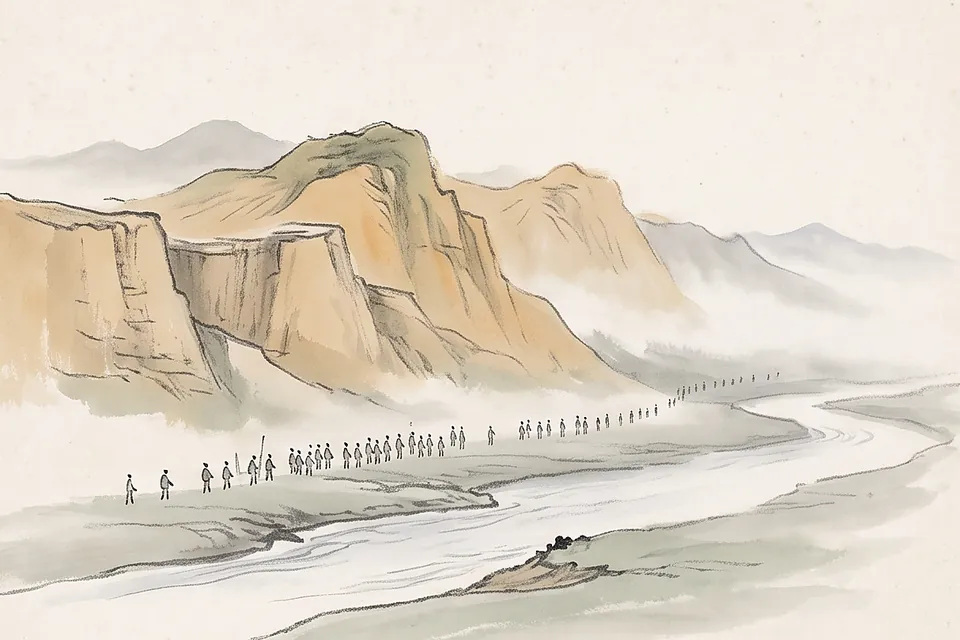
The matter demands organization, discipline, and an experienced commander. Strength without order is a mob; order makes it an army. Test whether your cause is just: only a right cause holds people in formation. Appoint the worthy — and give them full authority.
The Image
Water beneath the earth — strength gathered into a hidden reservoir. The task of the moment: turn scattered resources into organized structure. Three things are needed: a just cause (people must know what they fight for), an experienced leader with full authority, and discipline without cruelty. After victory, a separate care: keep chance people from the fruits.
Interpretation of hexagram 7
VII. The Sze Hexagram. to be very small. That the subject of the line should retire to so insignificant a place is further proof of his humility.
The lines of hexagram 7
First line
The first line, divided, shows the host going forth according to the rules (for such a movement). If these be not good, there will be evil.
Line 3 is weak and in an odd place. Its subject therefore is not equal to strive, but withdraws from the arena. Even if forced into it, he will keep himself in the background;—and be safe. ‘He keeps in the old place assigned for his support’ is, literally, ‘He eats his old virtue;’ meaning that he lives in and on the appanage assigned to him for his services.
Second line
The second line, undivided, shows (the leader) in the midst of the host. There will be good for¬ tune and no error. The king has thrice conveyed to him the orders (of his favour).
Line 4 is strong, and not in the centre; so that we are to con¬ ceive of its subject as having a mind to strive. But immediately above it is line 5, the symbol of the ruler, and with him it is hope¬ less to strive; immediately below is 3, weak, and out of its proper place, incapable of maintaining a contention. Its proper correlate is the lowest line, weak, and out of its proper place, from whom little help can come. Hence its subject takes the course indicated, which leads to good fortune.
Third line
The third line, divided, shows how the host may, possibly, have many inefficient leaders. There will be evil.
Line 5 has every circumstance in favour of its subject.
Fourth line
The fourth line, divided, shows the host in retreat. There is no error.
Line 6 is strong and able to contend successfully; but is there to be no end of striving ? Persistence in it is sure to end in defeat and disgrace. The contender here might receive a reward from the king for his success; but if he received it thrice in a morning, thrice it would be taken from him again. As to the nature of the reward here given, see on the Li K\, X, ii, 32.
Fifth line
The fifth line, divided, shows birds in the fields, which it will be advantageous to seize (and destroy). In that case there will be no error. If the oldest son leads the host, and younger men (idly occupy offices assigned to them), however firm and correct he may be, there will be evil.
P. Regis explains several of the expressions in the Text, both in the Thwan and the Hsiang, from the history of king Wan and his son king Wu. Possibly his own circumstances may have suggested to Wan some of the Thwan; and his course in avoiding a direct colli¬ sion with the tyrant Shau, and Wfi’s subsequent exploits may have been in the mind of the duke of K&a. Some of the sentiments, however, cannot be historically explained. They are general pro¬ tests against all contention and strife.
Top line
The topmost line, divided, shows the great ruler delivering his charges, (appointing some) to be rulers of states, and others to undertake the head¬ ship of clans; but small men should not be employed (in such positions).
and experience, there will be good fortune and no error.
Did hexagram 7 come up in your reading? The oracle itself gives the full reading, with changing lines and the second hexagram.
Cast the coins