Hexagram 40 · 解 · xiè
Hexagram 40. Xiè · Deliverance
☳☵ Thunder over water: Zhèn above, Kǎn below.
In (the state indicated by) An eh advantage will be found in the south-west. If no (further) opera¬ tions be called for, there will be good fortune in coming back (to the old conditions). If some opera¬ tions be called for, there will be good fortune in the early conducting of them.
In (the state indicated by) An eh advantage will be found in the south-west. If no (further) opera¬ tions be called for, there will be good fortune in coming back (to the old conditions). If some opera¬ tions be called for, there will be good fortune in the early conducting of them.
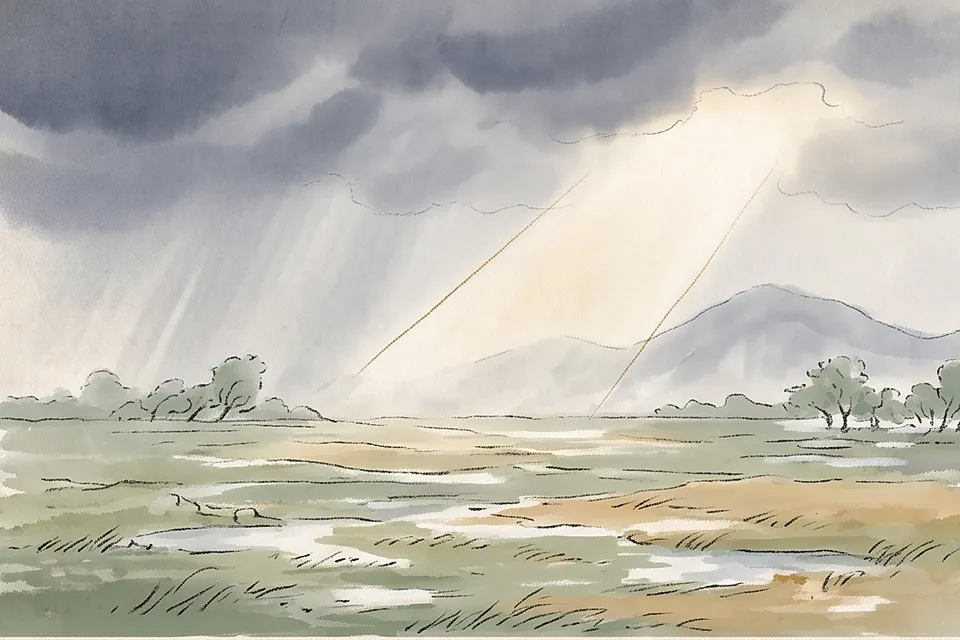
The storm has broken — and the air is cleared: tension released, the knot untied. Do not linger in what is past: forgive, cancel the debts, let the guilty go. What remains to be done, do quickly; after deliverance, delay only breeds new entanglements.
The Image
Thunder above water: the storm has passed, the air is clean. The crisis is resolved — now the release must be used rightly. Forgive and write off what is due for writing off: debts, grudges, suspended obligations. Close the remaining matters quickly, without perfectionism. Delay after deliverance is the commonest way to tie the next knot.
Interpretation of hexagram 40
XL. The Ateh Hexagram. i. The first line, divided, shows that its subject will commit no error.
The lines of hexagram 40
First line
The second line, undivided, shows its subject catch, in hunting, three foxes, and obtain the yellow ( = golden) arrows. With firm correctness there will be good fortune.
Line i is weak, whereas it ought to be strong as being in an odd place. If its subject advance, he will not be able to cope with the difficulties of the situation, but be overwhelmed by them. Let him wait for a more favourable time.
Second line
The third line, divided, shows a porter with his burden, (yet) riding in a carriage. He will (only) tempt robbers to attack him. However firm and correct he may (try to) be, there will be cause for regret.
Line 2 is weak, but in its proper place. Its correlation with the strong 5, and consequent significance, are well set forth.
Third line
(To the subject of) the fourth line, undivided, (it is said), 1 Remove your toes. Friends will (then) come, between you and whom there will be mutual confidence.’
Line 3 is strong, and in a place of strength; but its correlate in 6 is weak, so that the advance of its subject would be unsupported. He waits therefore for a better time, and cherishes the subjects of the two lines below, who naturally cling to him.
Fourth line
The fifth line, divided, shows (its subject), the superior man ( = the ruler), executing his function of removing (whatever is injurious to the idea of the hexagram), in which case there will be good fortune, and confidence in him will be shown even by the small men.
Line 4 is weak, and, though in its proper place, its subject could do little of himself. He is immediately below the king or great man, however, and cultivates his loyal attachment to him, waiting for the time when he shall be required to act.
Fifth line
In the sixth line, divided, we see a feudal prince (with his bow) shooting at a falcon on the top of a high wall, and hitting it. (The effect of his action) will be in every way advantageous.
Line 5 is the king, the man great and strong. He can cope with the difficulties, and the subjects of 2 and the other lines of the lower trigram give their help.
Top line
The action of the hexagram is over; where can the weak 6 go forward to ? Let him abide where he is, and serve the great man immediately below him. So shall he also be great;—in meritorious action at least.
Did hexagram 40 come up in your reading? The oracle itself gives the full reading, with changing lines and the second hexagram.
Cast the coins