Hexagram 17 · 隨 · suí
Hexagram 17. Suí · Following
☱☳ Lake over thunder: Duì above, Zhèn below.
Sui indicates that (under its conditions) there will be great progress and success. But it will be advan¬ tageous to be firm and correct. There will (then) be no error.
Sui indicates that (under its conditions) there will be great progress and success. But it will be advan¬ tageous to be firm and correct. There will (then) be no error.
A time to follow — circumstances, a worthy leader, the demand of the day. Following does not demean when it is deliberate: yield to what is right, not to what is strong. And know how to rest: at nightfall the superior man goes indoors for repose.
The Image
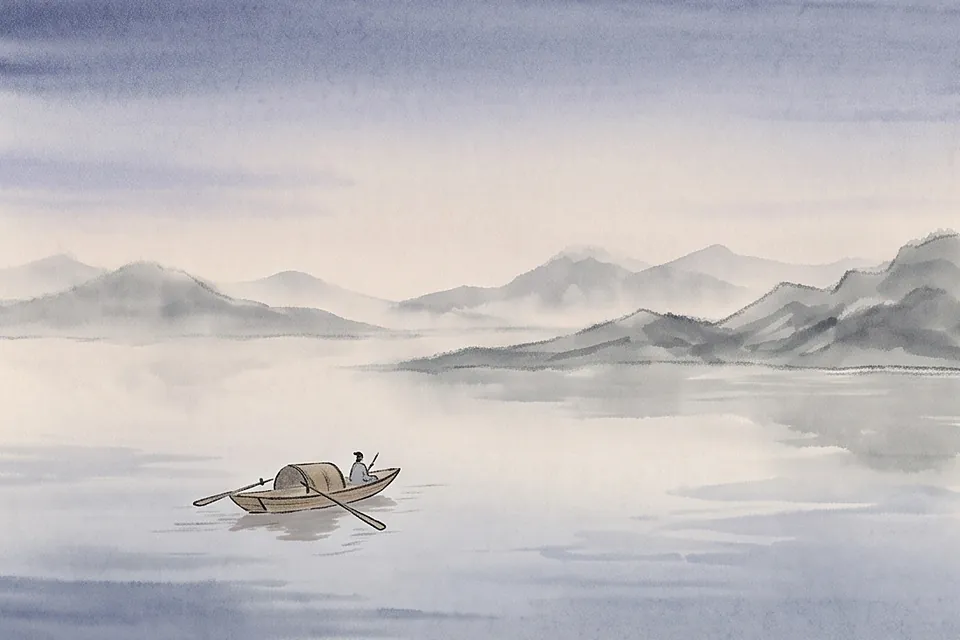
Thunder has settled into the lake: the strong has placed itself below the yielding — and so is followed. A time to follow circumstance and to lead by following: adapt to the day's demands without losing the aim. Follow what is right, not what is loud. And keep the rhythm of work and rest: following is a marathon, not a sprint.
Interpretation of hexagram 17
XVII. The Sui Hexagram. Hence he is represented as suffering from a chronic complaint, but nevertheless he does not die. See Appendix II on the line.
The lines of hexagram 17
First line
The first line, undivided, shows us one chang¬ ing the object of his pursuit; but if he be firm and correct, there will be good fortune. Going beyond (his own) gate to find associates, he will achieve merit.
Line 6, at the very top or end of the hexagram, is weak, and its subject is all but lost. Still even for him there is a chance of safety, if he will but change.
Second line
The second line, divided, shows us one who cleaves to the little boy, and lets go the man of age and experience.
XVII. Sui symbolises the idea of following. It is said to follow.Y u, the symbol of harmony and satisfaction. Where there are these conditions men are sure to follow; nor will they follow those in whom they have no complacency. The hexagram includes the cases where one follows others, and where others follow him; and the auspice of great progress and success is due to this flexi¬ bility and applicability of it. But in both cases the following must be guided by a reference to what is proper and correct. See the notes on the Thwan and the Great Symbolism.
Third line
The third line, divided, shows us one who cleaves to the man of age and experience, and lets go the little boy. Such following will get what it seeks ; but it will be advantageous to adhere to what is firm and correct.
Line 1 is strong, and lord of the lower trigram. The weak lines ought to follow it; but here it is below them, in the lowest place of the figure. This gives rise to the representation of one changing his pursuit. Still through the native vigour indicated by the line being strong, and in its correct place, its subject will be fortunate. Going beyond his gate to find associates indicates his public spirit, and superiority to selfish considerations.
Fourth line
The fourth line, undivided, shows us one followed and obtaining (adherents). Though he be firm and correct, there will be evil. If he be sincere (however) in his course, and make that evident, into what error will he fall ?
Line 2 is weak. Its proper correlate is the strong 5; but it prefers to cleave to the line below, instead of waiting to follow 5. Hence the symbolism of the text, the bad omen of which needs not to be mentioned.
Fifth line
The fifth line, undivided, shows us (the ruler) sincere in (fostering all) that is excellent. There will be good fortune.
Line 3 is also weak, but it follows the strong line above it and leaves line 1, reversing the course of 2 ;—with a different issue. It is w r eak, however, and 4 is not its proper correlate; hence the con¬ clusion of the paragraph is equivalent to a caution.
Top line
The topmost line, divided, shows us (that sin¬ cerity) firmly held and clung to, yea, and bound fast. (We see) the king with it presenting his offerings on the western mountain.
Line 4 is strong, and in the place of a great minister next the ruler in 5. But his having adherents may be injurious to the supreme and sole authority of that ruler, and only a sincere loyalty will save him from error and misfortune.
Did hexagram 17 come up in your reading? The oracle itself gives the full reading, with changing lines and the second hexagram.
Cast the coins