Hexagram 46 · 升 · shēng
Hexagram 46. Shēng · Pushing Upward
☷☴ Earth over wind: Kūn above, Xùn below.
Shang indicates that (under its conditions) there will be great progress and success. Seeking by
Shang indicates that (under its conditions) there will be great progress and success. Seeking by
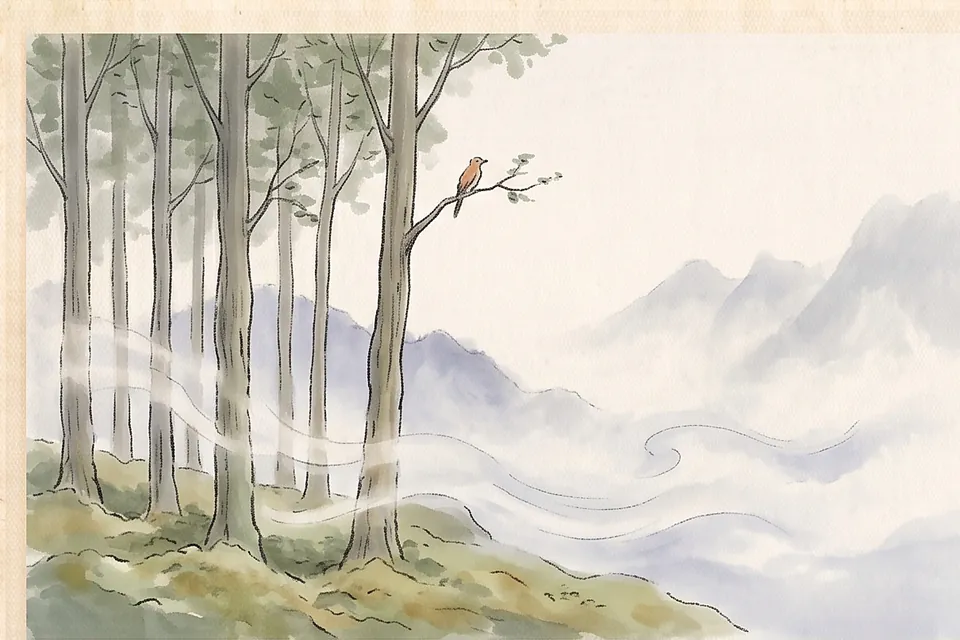
A tree grows up out of the earth: an ascent unhurried yet irresistible — not a leap but a growth. Advance step by step, accumulating the small into the great; approach those above without timidity — they are ready to receive you. Effort is rewarded now: go, and do not be anxious.
The Image
A tree grows within the earth: an ascent unnoticeable yet irresistible. Your strategy is growth, not a leap: step by step, stair by stair, small accumulating into great. The doors above are open now: approach those higher without timidity — they are ready to receive you. The single prohibition: skipping steps.
Interpretation of hexagram 46
XLVI. The Shang Hexagram. be the best that can be obtained, and other things will be in har¬ mony with them.
The lines of hexagram 46
First line
The first line, divided, shows its subject ad¬ vancing upwards with the welcome (of those above him). There will be great good fortune.
Line i is weak, and in the place of a strong line. It has a proper correlate in 4, but is separated from him by the intervention of two weak lines. The consequence of these things is supposed to be expressed in the first part of the symbolism; but the subject of the line is possessed by the desire for union, which is the theme of the hexagram. Calling out to his correlate for help, he obtains it, and his sorrow is turned into joy.
Second line
The second line, undivided, shows its subject with that sincerity which will make even the (small) offerings of the vernal sacrifice acceptable. There will be no error.
Line 2 is in its proper place, and responds to the strong ruler in 5, who encourages and helps the advance of its subject. He possesses also the sincerity, proper to him in his central position; and though he were able to offer only the sacrifice of the spring, small compared with the fulness of the sacrifices in summer and autumn, it would be accepted.
Third line
The third line, undivided, shows its subject ascending upwards (as into) an empty city.
Line 3 is weak, in the place of a strong line, and advanced from the central place. The topmost line, moreover, is no proper correlate. But its subject is possessed by the desire for union; and though 2 and 4 decline to associate with him, he presses on to 6, which is also desirous of union. That common desire brings them together, notwithstanding 3 and 6 are both divided lines ; and with difficulty the subject of 3 accomplishes his object.
Fourth line
The fourth line, divided, shows its subject employed by the king to present his offerings on mount Khi. There will be good fortune ; there will be no mistake.
[But that an ordinary rule for interpreting the lineal indications may be thus overruled by extraordinary considerations shows how much of fancy there is in the symbolism or in the commentaries on it.]
Fifth line
The fifth line, divided, shows its subject firmly correct, and therefore enjoying good fortune. He ascends the stairs (with all due ceremony).
Line 4 has its correlate in 1, and is near to the ruling line in 5. We may expect a good auspice for it; but its being strong in an odd place, calls for the caution which is insinuated.
Top line
The sixth line, divided, shows its subject ad¬ vancing upwards blindly. Advantage will be found in a ceaseless maintenance of firm correctness.
Line 5 is strong, central, and in its correct position. Through
Square brackets mark words absent from the Chinese original: Legge supplied them from the sense of the passage and from parallel places. Angle brackets mark connectives added so that the sentence reads in English. Nothing is silently smoothed over — every addition by the translator is marked.
Did hexagram 46 come up in your reading? The oracle itself gives the full reading, with changing lines and the second hexagram.
Cast the coins