Hexagram 4 · 蒙 · méng
Hexagram 4. Méng · Youthful Folly
☶☵ Mountain over water: Gèn above, Kǎn below.
Mang (indicates that in the case which it pre¬ supposes) there will be progress and success. I do not (go and) seek the youthful and inexperienced,
Mang (indicates that in the case which it pre¬ supposes) there will be progress and success. I do not (go and) seek the youthful and inexperienced,
A time of apprenticeship. Not knowing is no vice; refusing to learn and pestering with the same question is. Find one who knows the way and ask once — in earnest. If you are the one asked, answer only those truly ready to hear.
The Image
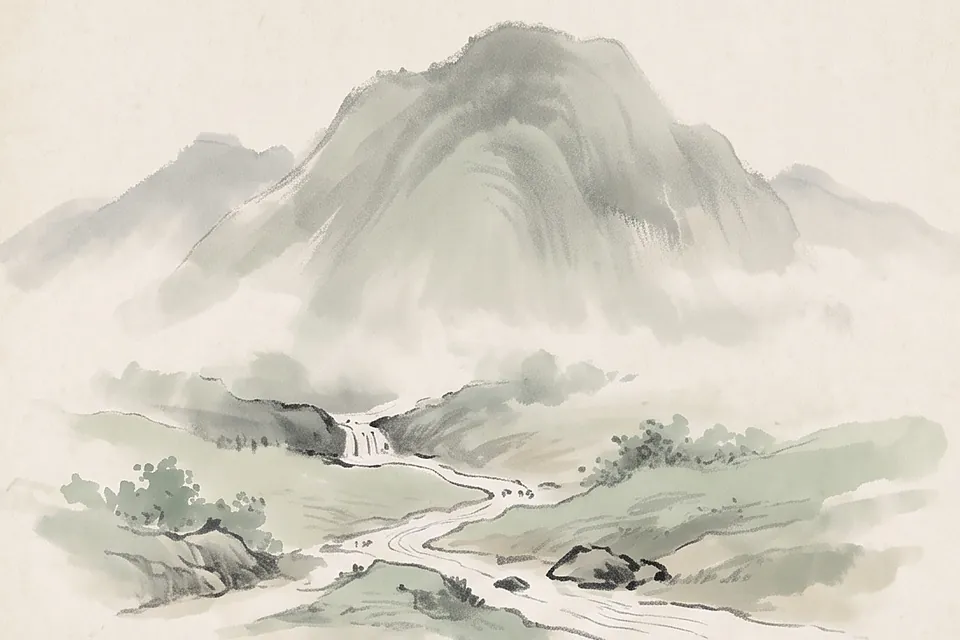
A spring at the mountain's foot: knowledge already rising, but no channel yet. The position of a student — or a teacher. If learning: find a true mentor, ask in earnest, and do not re-ask from anxiety. If teaching: be strict at the start, patient in the middle, and do not answer those who ask idly. Immaturity is a stage, not a vice; the vice is to remain in it.
Interpretation of hexagram 4
IV. The Mang Hexagram. trigram of peril; and the lowest line of that, to which especially he must look for response and co-operation, is divided and weak. Hence arise the ideas of difficulty in advancing, the necessity of caution, and the advantage of his being clothed with authority.
The lines of hexagram 4
First line
The first line, divided, (has respect to) the dispelling of ignorance. It will be advantageous to use punishment (for that purpose), and to re¬ move the shackles (from the mind). But going on in that way (of punishment) will give occasion for regret.
To the subject of the second line, divided, advance is still more difficult. He is weak in himself; he is pressed by the subject of the strong line below him. But happily that subject, though strong, is correct; and above in the fifth line, in the place of authority, is the strong one, union with whom and the service of whom should be the objects pursued. All these circumstances suggested to the duke of Aau the idea of a young lady, sought in marriage by a strong wooer, when marriage was unsuitable, rejecting him, and finally, after ten years, marrying a more suitable, the only suitable, match for her.
Second line
The second line, undivided, (shows its subject) exercising forbearance with the ignorant, in which there will be good fortune; and admitting (even the goodness of women, which will also be fortunate. (He may be described also as) a son able to (sustain the burden of) his family.
The third line is divided, not central, and the number of its place is appropriate to the occupancy of a strong line. All these things should affect the symbolism of the line. But the outcome of the whole hexagram being good, the superior man sees the imme¬ diate danger and avoids it.
Third line
The third line, divided, (seems to say) that one should not marry a woman whose emblem it might be, for that, when she sees a man of wealth, she will not keep her person from him, and in no wise will advantage come from her.
The subject of the fourth line, the first of the upper trigram, has recourse to the strong suitor of line i, the first of the lower trigram; and with his help is able to cope with the difficulties of the position, and go forward.
Fourth line
The fourth line, divided, (shows its subject as if) bound in chains of ignorance. There will be occasion for regret.
The subject of the fifth line is in the place of authority, and should show himself a ruler, dispensing benefits on a great scale. But he is in the very centre of the trigram denoting perilousness, and line 2, which responds to 5, is weak. Hence arises the sym¬ bolism, and great things should not be attempted.
Fifth line
The fifth line, divided, shows its subject as a simple lad without experience. There will be good fortune.
The sixth line is weak; the third responding to it is also weak ; it is at the extremity of peril; the game is up. What can remain for its subject in such a case but terror and abject weeping ?
Top line
In the topmost line, undivided, we see one smiting the ignorant (youth). But no advantage
THE MANG HEXAGRAM.
Did hexagram 4 come up in your reading? The oracle itself gives the full reading, with changing lines and the second hexagram.
Cast the coins