Hexagram 31 · 咸 · xián
Hexagram 31. Xián · Influence
☱☶ Lake over mountain: Duì above, Gèn below.
Hsien indicates that, (on the fulfilment of the conditions implied in it), there will be free course and success. Its advantageousness will depend on the being firm and correct, (as) in marrying a young lady. There will be good fortune.
Hsien indicates that, (on the fulfilment of the conditions implied in it), there will be free course and success. Its advantageousness will depend on the being firm and correct, (as) in marrying a young lady. There will be good fortune.
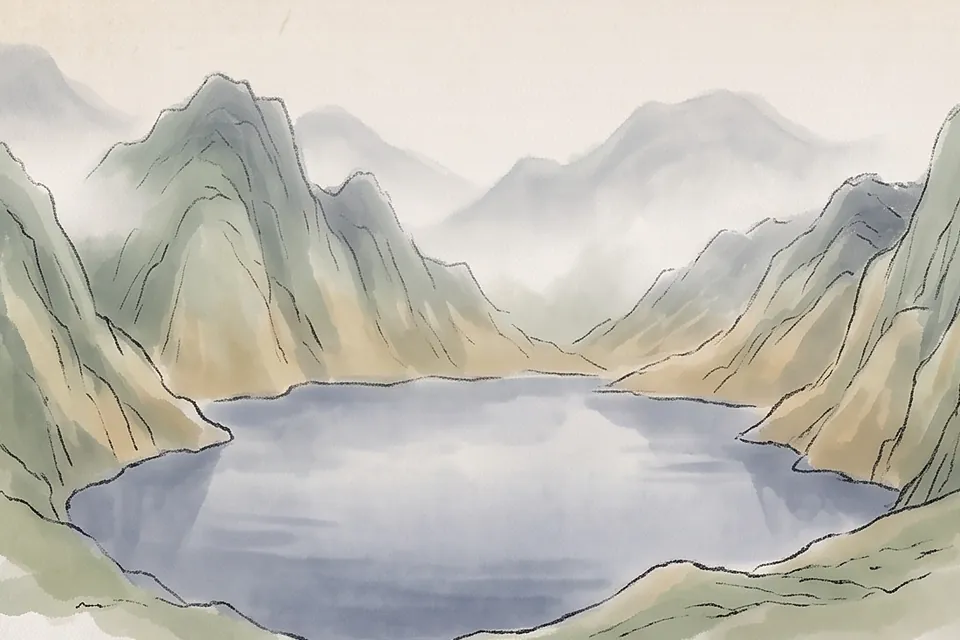
A lake on the mountain's summit: the strong has bowed before the tender, and mutual attraction is born. A time of drawing together — souls, partners, ideas. Influence not by pressure but by openness: keep the heart free of bias and others will be drawn to you. Lasting unions are made now.
The Image
A lake on the mountain's summit: the strong has bowed, the yielding has answered — mutual attraction. The best of times for unions, partnerships, beginnings of relationships. The mechanics of influence are subtle: what acts is not pressure but openness — an empty, unbiased heart with room for the other to enter. Fussiness and calculation now repel more than rudeness.
Interpretation of hexagram 31
XXXI. The Hsien Hexagram. XXXI. With the 31st hexagram commences the Second Section of the Text. It is difficult to say why any division of the hexagrams should be made here, for the student tries in vain to discover any con¬ tinuity in the thoughts of the author that is now broken. The First Section does not contain a class of subjects different from those which w'e find in the Second. That the division was made, how¬ ever, at a very early time, appears from the sixth Appendix on the Sequence of the Hexagrams, where the writer sets forth an analogy between the first and second figures, representing heaven and earth, as the originators of all things, and this figure and the next, repre¬ senting (each of them) husband and wife, as the originators of all the social relations. This, however, is far from carrying conviction to my mind. The division of the Text of the Yi into two sections is a fact of which I am unable to give a satisfactory account.
The lines of hexagram 31
First line
The first line, divided, shows one moving his great toes.
Hsien, as explained in the treatise on the Thwan, has here the meaning of mutual influence, and the duke of Wau, on the various lines, always uses Kan for it in the sense of ‘ moving ’ or ‘ influenc¬ ing to movement or action.’ This is to my mind the subject of the hexagram considered as an essay,—‘Influence; the different ways of bringing it to bear, and their issues.’
Second line
The second line, divided, shows one moving the calves of his leg. There will be evil. If he abide (quiet in his place), there will be good fortune.
The Chinese character called hsien is the graphic symbol for ‘ all, together, jointly.’ Kan, the symbol for 1 influencing,’ has hsien in it as its phonetic constituent (though the changes in pro¬ nunciation make it hard for an English reader to appreciate this), with the addition of hsin, the symbol for ‘the heart.’ Thus kan,‘to affect or influence,’= + i \^; and it may have been
Third line
The third line, undivided, shows one moving his thighs, and keeping close hold of those whom he follows. Going forward (in this way) will cause regret.
that while the name or word was used with the significance of ‘ influencing,’ the was purposely dropt from it, to indicate the most important element in the thing,—the absence of all purpose or motive. I venture to think that this would have been a device worthy of a diviner.
Fourth line
The fourth line, undivided, shows that firm correctness which will lead to good fortune, and prevent all occasion for repentance. If its subject be unsettled in his movements, (only) his friends will follow his purpose.
With regard to the idea of husband and wife being in the teach¬ ing of the hexagram, it is derived from the more recent symbolism of the eight trigrams ascribed to king Wan, and exhibited on p. 33 and plate III. The more ancient usage of them is given in the paragraph on the Great Symbolism of Appendix II. The figure consists of Kan (= zzz), ‘the youngest son,’ and over it Tui (:EE=E=)j ‘ the youngest daughter.’ These are in ‘ happy union.’
Fifth line
The fifth line, undivided, shows one moving the flesh along the spine above the heart. There will be no occasion for repentance.
THE HANG HEXAGRAM.
Top line
The sixth line, divided, shows one moving his jaws and tongue.
Did hexagram 31 come up in your reading? The oracle itself gives the full reading, with changing lines and the second hexagram.
Cast the coins