Hexagram 52 · 艮 · gèn
Hexagram 52. Gèn · Keeping Still, Mountain
☶☶ Mountain over mountain: Gèn above, Gèn below.
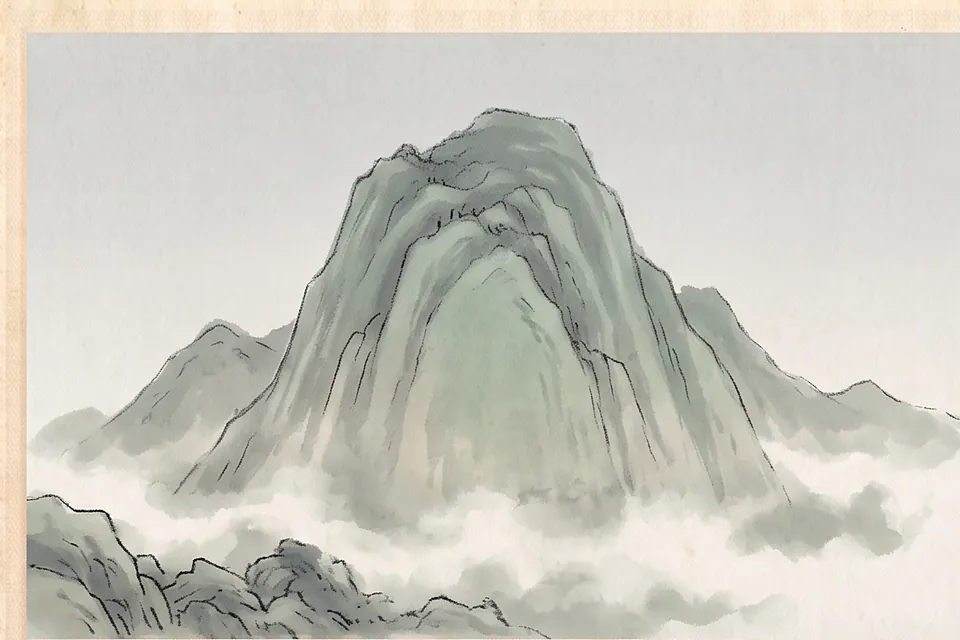
When one’s resting is like that of the back, and he loses all consciousness of self; when he walks
When one’s resting is like that of the back, and he loses all consciousness of self; when he walks
Mountain upon mountain: complete stillness. Stop motion where it is time for motion to stop — down to stilling thoughts about oneself. This is not flight from the world but composure: who can be still at the right instant can also act at the right instant.
The Image
Mountain upon mountain: complete stillness, motion halted at its proper moment. Not flight from the world but hygiene of the will: to stop an action when its time to stop has come, down to stopping thoughts about oneself. The practice is simple: finish — and do not continue in the head; be where you are. Who commands the pause commands the move: from true stillness, action emerges precise.
Interpretation of hexagram 52
LII. The Kan H EXAGRAM. The next sentence shows him sensible of the danger of the occasion, but confident and self-possessed. The concluding sen¬ tence shows him rapt in his own important affairs, like a sincere worshipper, thinking only of the service in which he is engaged. Such a symbol is said to be suggested by Wan’s significance of Wan as ‘the oldest son (page 33).’ It is his to succeed to his father, and the hexagram, as following Ting, shows him presiding over the sacrifices that have been prepared in the caldron. This is too fanciful.
The lines of hexagram 52
First line
The first line, divided, shows its subject keep¬ ing his toes at rest. There will be no error; but it will be advantageous for him to be persistently firm and correct.
What is said on line 1 is little more than a repetition of the principal part of the Thwan. The line is undivided, and gives the auspice of good fortune.
Second line
The second line, divided, shows its subject keeping the calves of his legs at rest. He cannot help (the subject of the line above) whom he fol¬ lows, and is dissatisfied in his mind.
‘ The position of peril’ to the subject of line 2 is suggested, as Appendix II says, by its position, immediately above 1. But the rest of the symbolism is obscure, and Wu Hsi says he does not understand it. The common interpretation appears in the version. The subject of the line does what he can to get out of danger; and finally, as is signified by the central position of the line, the issue is better than could have been expected. On the specification of ‘seven days,’ see what is said in the treatise on the Thwan of hexagram 24. On its use here WMng-jze says:—‘ The places of a diagram amount to 6. The number 7 is the first of another. When the movement symbolised by Wan is gone by, things will be as they were before.’
Third line
The third line, undivided, shows its subject keeping his loins at rest, and separating the ribs (from the body below). The situation is perilous, and the heart glows with suppressed excitement.
Line 3 is divided, and where an undivided line should be; but if its subject move on to the fourth place, which would be right for him, the issue will not be bad.
Fourth line
The fourth line, divided, shows its subject keeping his trunk at rest. There will be no error.
The 4th line, however, has a bad auspice of its own. It is undi¬ vided in an even place, and it is pressed by the divided line on
Fifth line
The fifth line, divided, shows its subject keep¬ ing his jawbones at rest, so that his words are (all) orderly. Occasion for repentance will disappear.
in his courtyard, and does not see any (of the per¬ sons) in it,—there will be no error.
Top line
The sixth line, undivided, shows its subject
either side, hence its subject is represented as supinely sinking in the mud.
Did hexagram 52 come up in your reading? The oracle itself gives the full reading, with changing lines and the second hexagram.
Cast the coins