Hexagram 18 · 蠱 · gǔ
Hexagram 18. Gǔ · Work on What Has Been Spoiled
☶☴ Mountain over wind: Gèn above, Xùn below.
Kfi indicates great progress and success (to him who deals properly with the condition represented by it). There will be advantage in (efforts like that of) crossing the great stream. (He should weigh well, however, the events of) three days before the turning point, and those (to be done) three days after it.
Kfi indicates great progress and success (to him who deals properly with the condition represented by it). There will be advantage in (efforts like that of) crossing the great stream. (He should weigh well, however, the events of) three days before the turning point, and those (to be done) three days after it.
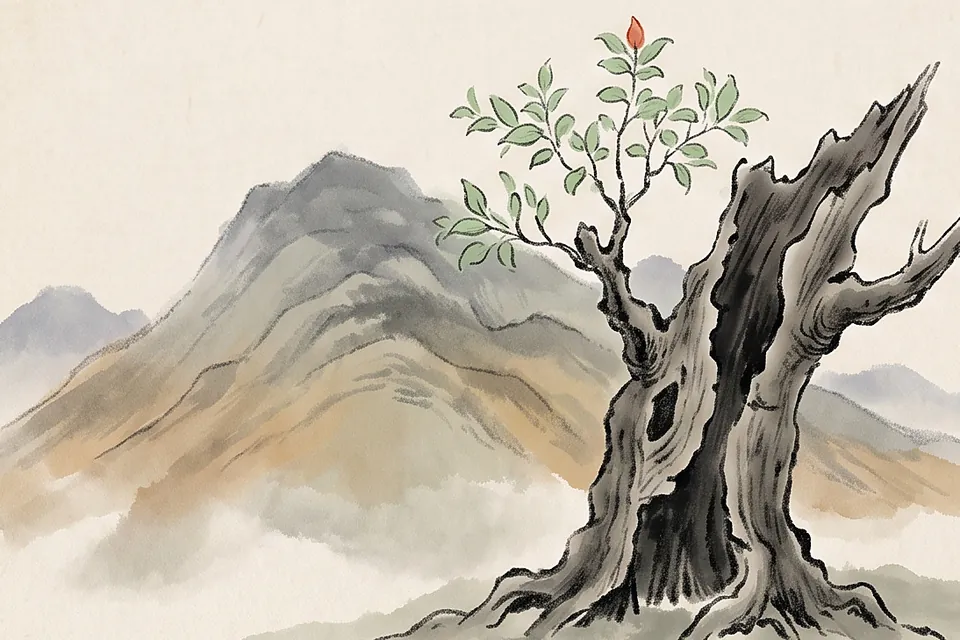
Worms breed in the vessel: what was left unattended has decayed — affairs, relations, the fathers' legacy. Decay is not a verdict but a task: caused by people, it can be repaired by people. Deliberate three days before the step, and verify for three days after.
The Image
Wind at the mountain's foot circles and cannot leave: stagnation, in which decay breeds. The spoiled — affairs, relations, inherited practices — will not dissolve; it is repaired by hand. Diagnose the cause (usually someone's long connivance), plan the repair with the margin of 'three days before and three after' — preparation and follow-through matter more than the push itself.
Interpretation of hexagram 18
XVIII. The Kft Hexagram. what is right. This influence not only extends to men, but also to spiritual beings. ‘ The western hill ’ is mount Kh\, at the foot of which was the original settlement of the house of Aau, in b. c. 1325. The use of the name ‘king’ here brings us down from Wan into the time of king Wfl at least.
The lines of hexagram 18
First line
The first line, divided, shows (a son) dealing with the troubles caused by his father. If he be an (able) son, the father will escape the blame of having erred. The position is perilous, but there will be good fortune in the end.
indulgently the troubles caused by his father. If he go forward, he will find cause to regret it.
Second line
The second line, undivided, shows (a son) dealing with the troubles caused by his mother. He should not (carry) his firm correctness (to the utmost).
XVIII. In the 6th Appendix it is said, ‘ They who follow another are sure to have services (to perform), and hence Sui is followed by Kft.’ But Ku means the having painful or troublesome services to do. It denotes here a state in which things are going to ruin, as if through poison or venomous worms; and the figure is sup¬ posed to describe the arrest of the decay and the restoration to soundness and vigour, so as to justify its auspice of great progress and success. To realise such a result, however, great efforts will be required, as in crossing the great stream; and a careful con¬ sideration of the events that have brought on the state of decay, and the measures to be taken to remedy it is also necessary. See Appendix I on the 1 three days.’
Third line
The third line, undivided, shows (a son) dealing with the troubles caused by his father. There may be some small occasion for repentance, but there will not be any great error.
The subject of line 1, and of all the other lines, excepting per¬ haps 6, appears as a son. Yet the line itself is of the yin nature, and the trigram in which it plays the principal part is also yin. Line 2 is strong, and of the yang nature, with the yin line 5 as its proper correlate. In line 2, 5 appears as the mother; but its sub¬ ject there is again a son, and the upper trigram altogether is yang. I am unable to account for these things. As is said in the note of Regis on line 2 :—‘ Haec matris filiique denominatio ad has lineas mere translatitia est, et, ut ait commentarius vulgaris, ad explicatio- nem sententiarum eas pro matre et filio supponere dicendum est. Nec ratio reddetur si quis in utroque hoc nomine mysterium quaerat. Cur enim aliis in figuris lineae nunc regem, nunc vasal- lum, jam imperii administrum, mox summum armorum praefectum referre dicantur? Accommodantur scilicet lineae ad verba sententiae et verba sententiae ad sensum, quemadmodum faci¬ endum de methodis libri Shih King docet Mencius, V, i, ode 4.2.’
Fourth line
The fourth line, divided, shows (a son) viewing
We must leave this difficulty. Line 1 is weak, and its correlate 4 is also weak. What can its subject do to remedy the state of decay? But the line is the first of the figure, and the decay is not
Fifth line
The fifth line, divided, shows (a son) dealing with the troubles caused by his father. He obtains the praise of using (the fit instrument for his work).
THE LIN HEXAGRAM.
Top line
The sixth line, undivided, shows us one who does not serve either king or feudal lord, but in a lofty spirit prefers (to attend to) his own affairs.
Did hexagram 18 come up in your reading? The oracle itself gives the full reading, with changing lines and the second hexagram.
Cast the coins