Hexagram 15 · 謙 · qiān
Hexagram 15. Qiān · Modesty
☷☶ Earth over mountain: Kūn above, Gèn below.
KAien indicates progress and success. The su¬ perior man, (being humble as it implies), will have a (good) issue (to his undertakings).
KAien indicates progress and success. The su¬ perior man, (being humble as it implies), will have a (good) issue (to his undertakings).
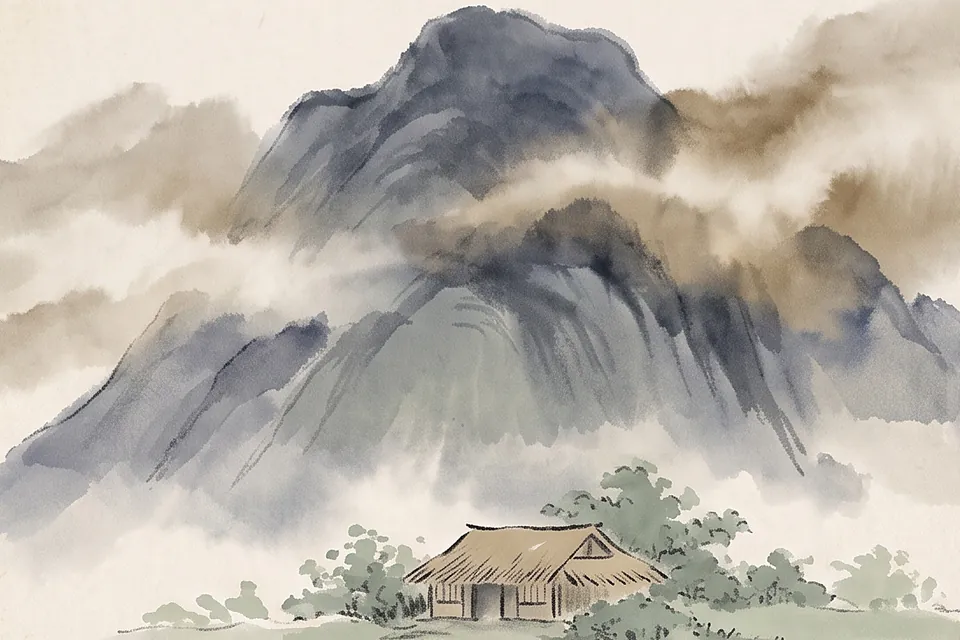
A mountain hidden within the earth: greatness that does not display itself. Modesty here is not weakness but the law of balance — the full is diminished, the modest increased. Do the work and claim no credit: precisely this now opens every door.
The Image
A mountain sunk within the earth: the great that does not display itself. The law of the moment is leveling: the overfull diminishes, the modest increases. Practically: lower the self-presentation, raise the quality; yield in form, win in substance. Modesty here is not passivity — it is compatible with firm action, but excludes playing to the gallery.
Interpretation of hexagram 15
XV. The Khizn Hexagram. state of opulence. The danger threatening such a condition arises from the pride which it is likely to engender. But everything here is against that issue. Apart from the symbolism of the trigrams, we have the place of honour occupied by a weak line, so that its subject will be humble; and all the other lines, strong as they are, will act in obedient sympathy. There will be great progress and success.
The lines of hexagram 15
First line
The first line, divided, shows us the superior man who adds humility to humility. (Even) the great
Line 1, though strong, is at the lowest part of the figure, and has no correlate above. No external influences have as yet acted injuriously on its subject. Let him do as directed, and no hurtful influence will ever affect him.
Second line
The second line, divided, shows us humility that has made itself recognised. With firm correct¬ ness there will be good fortune.
The strong line 2 has its proper correlate in line 5, the ruler of the figure, and will use its strength in subordination to his humility. Hence the symbolism.
Third line
The third line, undivided, shows the superior man of (acknowledged) merit. He will maintain his success to the end, and have good fortune.
Line 3 is strong, and in the right (an odd) place. The top¬ most line of the lower trigram is the proper place for a feudal lord. The subject of this will humbly serve the condescending ruler in line 5. A small man, having the place without the virtue, would give himself airs.
Fourth line
The fourth line, divided, shows one, whose action would be in every way advantageous, stirring up (the more) his humility.
Line 4 is strong, but the strength is tempered by the position, which is that of a weak line. Hence he will do no injury to the mild ruler, to whom he is so near.
Fifth line
The fifth line, divided, shows one who, without being rich, is able to employ his neighbours. He may advantageously use the force of arms. All his movements will be advantageous.
Line 5 symbolises the ruler. Mild sincerity is good in him, and affects his ministers and others. But a ruler must not be without an awe-inspiring majesty.
Top line
The sixth line, divided, shows us humility that has made itself recognised. The subject of it will with advantage put his hosts in motion ; but (he will only) punish his own towns and state.
Even the topmost line takes its character from 5. The strength of its subject is still tempered, and Heaven gives its approval.
Did hexagram 15 come up in your reading? The oracle itself gives the full reading, with changing lines and the second hexagram.
Cast the coins