Hexagram 53 · 漸 · jiàn
Hexagram 53. Jiàn · Development
☴☶ Wind over mountain: Xùn above, Gèn below.
Afien suggests to us the marriage of a young lady, and the good fortune (attending it). There will be advantage in being firm and correct.
Afien suggests to us the marriage of a young lady, and the good fortune (attending it). There will be advantage in being firm and correct.
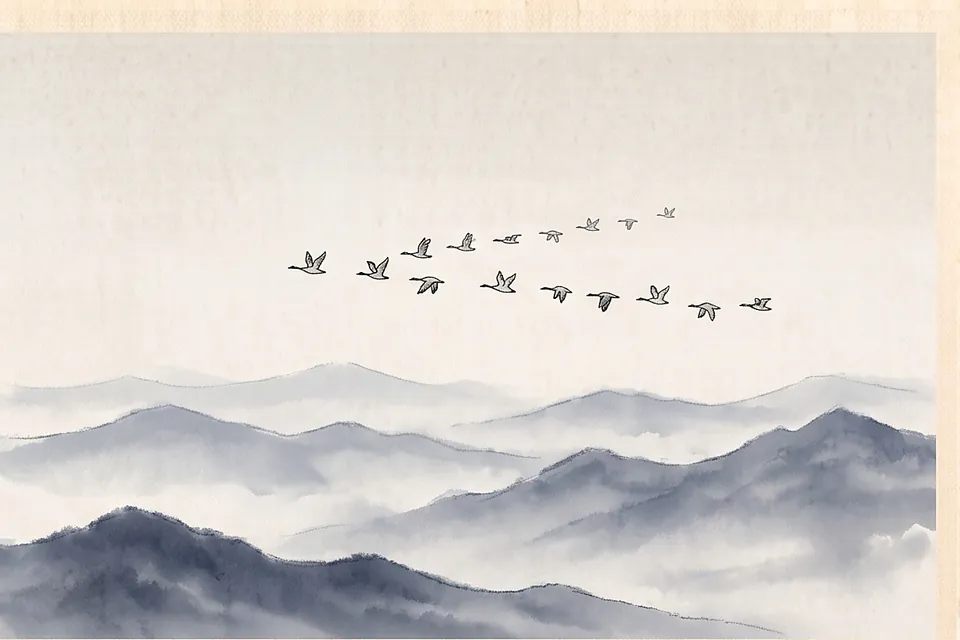
The wild goose draws gradually nearer the shore: gradualness. As a tree on the mountain grows imperceptibly and therefore firmly, so your affair requires stages and observances, not a leap. Do not shorten the way: slow approach, earned trust, deep rooting — the only reliable course.
The Image
A tree on the mountain grows slowly and therefore firmly. Your process is gradualness: career, relationships, reputation, taking root in a new place. Gradualness has its own craft: stages, observances, consolidated states; each next step from a foothold, not from air. Do not shorten the way: the skipped stage takes its revenge later, hardest of all.
Interpretation of hexagram 53
LI 11 . The A"ien Hexagram. i. The first line, divided, shows the wild geese gradually approaching the shore. A young officer (in similar circumstances) will be in a position of danger, and be spoken against; but there will be no error.
The lines of hexagram 53
First line
The second line, divided, shows the geese gradually approaching the large rocks, where they eat and drink joyfully and at ease. There will be good fortune.
follows 3, and should help it; but is unable to do so; and there results dissatisfaction.
Second line
The third line, undivided, shows them gradu¬ ally advanced to the dry plains. (It suggests also the idea of) a husband who goes on an expedition from which he does not return, and of a wife who is pregnant, but will not nourish her child. There will be evil. (The case symbolised) might be advan¬ tageous in resisting plunderers.
When the calves are kept at rest, advance is stopped, but no other harm ensues. Not so when the loins are kept at rest, and unable to bend, for the connexion between the upper and lower parts of the body is then broken. The dissatisfaction increases to an angry heat. Paragraph 3 is unusually difficult. For ‘ loins ’ P. Regis has scapulae, and for ribs renes; Canon McClatchie says:—‘Third Nine is stopping at a limit, and separating what is in continued succession (i. e. the backbone); thus the mind,’ &c.
Third line
The fourth line, divided, shows the geese gradually advanced to the trees. They may light on the flat branches. There will be no error.
Line 4 is a weak line resting in a proper place; hence it gives a good auspice. The Khang-hsi editors, however, call attention to the resting of the trunk as being inferior to the resting of the back in the Thwan.
Fourth line
The fifth line, undivided, shows the geese gradually advanced to the high mound. (It sug¬ gests the idea of) a wife who for three years does not become pregnant; but in the end the natural issue cannot be prevented. There will be good fortune.
The place of the weak fifth line is not proper for it; and this accounts for the mention of its subject ‘ repenting,’ for which, however, there is not occasion.
Fifth line
The sixth line, undivided, shows the geese gradually advanced to the large heights (beyond). Their feathers can be used as ornaments. There will be good fortune.
The third line of the trigrams, and the sixth of the hexagram, is what makes Kan what it is,—the symbol of a mountain. The subject of it therefore will carry out the resting required by the whole figure in the highest style.
Top line
THE JTIEN HEXAGRAM.
Did hexagram 53 come up in your reading? The oracle itself gives the full reading, with changing lines and the second hexagram.
Cast the coins