Hexagram 21 · 噬嗑 · shì kè
Hexagram 21. Shì Kè · Biting Through
☲☳ Fire over thunder: Lí above, Zhèn below.
Shih Ho indicates successful progress (in the con¬ dition of things which it supposes). It will be advantageous to use legal constraints.
Shih Ho indicates successful progress (in the con¬ dition of things which it supposes). It will be advantageous to use legal constraints.
An obstacle is lodged between the jaws — it must be bitten through. Something obstructs the matter and will not dissolve by itself: a lie, an abuse, a knot of contradiction. An energetic, precise effort is needed — and justice without cruelty: the penalty must fit the fault.
The Image
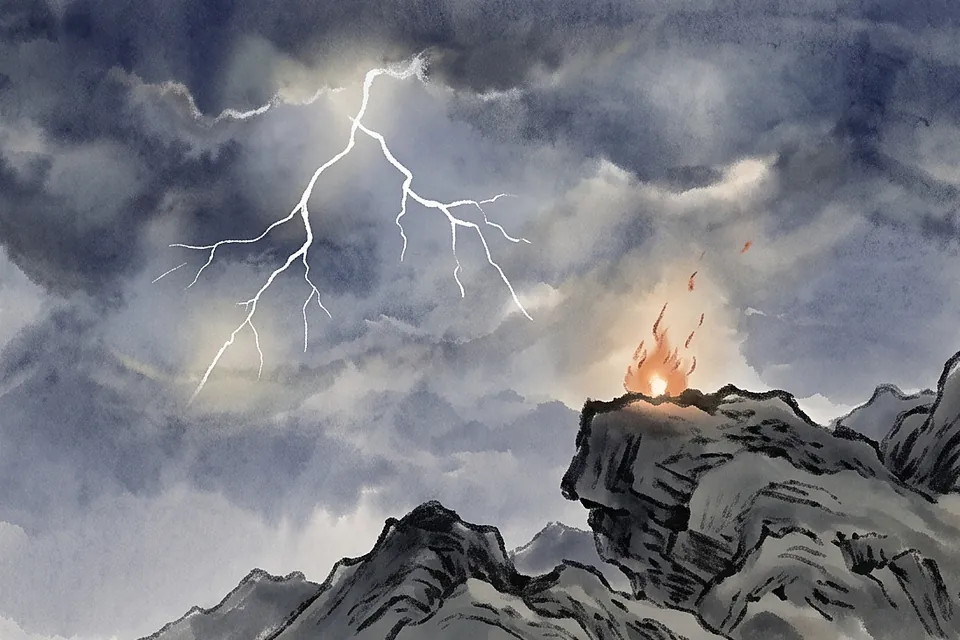
Thunder and lightning: a discharge that breaks the obstruction. Between you and the aim stands an artificial barrier — deceit, abuse, a knot of interests. It will not dissolve by itself; a precise, energetic act is needed: expose, name, remove. Act by right and in measure: a penalty exceeding the fault creates a new obstruction in place of the old.
Interpretation of hexagram 21
XXI. The Shih Ho Hexagram. the symbol of a thoughtless lad, who cannot see far, and takes only superficial views.
The lines of hexagram 21
First line
The first line, undivided, shows one with his feet in the stocks and deprived of his toes. There will be no error.
Line 2 is also weak, but in its proper place, showing a woman, living retired, and only able to peep as from her door at the subject of the fifth line. But ignorance and retirement are proper in a woman.
Second line
The second line, divided, shows one biting through the soft flesh, and (going on to) bite off the nose. There will be no error.
Line 3, at the top of the lower trigram Khwan, and weak, must belong to a subject of the utmost docility, and will wish to act only according to the exigency of time and circumstances.
Third line
The third line, divided, shows one gnawing dried flesh, and meeting with what is disagreeable. There will be occasion for some small regret, but no (great) error.
Line 4, in the place proper to its weakness, is yet in immediate proximity to 5, representing the sovereign. Its subject is moved accordingly, and stirred to ambition.
Fourth line
The fourth line, undivided, shows one gnawing the flesh dried on the bone, and getting the pledges of money and arrows. It will be advantageous to him to realise the difficulty of his task and be firm,— in which case there will be good fortune.
Line 5 is strong, and in the place of the ruler. He is a superior man, but this does not relieve him from the duty of self-contempla¬ tion or examination.
Fifth line
The fifth line, divided, shows one gnawing at dried flesh, and finding the yellow gold. Let him be firm and correct, realising the peril (of his posi¬ tion). There will be no error.
There is a slight difference in the 6th paragraph from the 5th, which can hardly be expressed in a translation. By making a change in the punctuation, however, the different significance may be brought out. Line 6 is strong, and should be considered out of the work of the hexagram, but its subject is still possessed by the spirit of its idea, and is led to self-examination.
Top line
The sixth line, undivided, shows one wearing the cangue, and deprived of his ears. There will be evil.
XXI. Shih Ho means literally 1 Union by gnawing.’ We see in the figure two strong lines in the first and last places, while all the others, with the exception of the fourth, are divided. This suggests the idea of the jaws and the mouth between them kept open by some¬ thing in it. Let that be gnawed through and the mouth will close and the jaws come together. So in the body politic. Remove the obstacles to union, and high and low will come together with a good understanding. And how are those obstacles to be removed ? By force, emblemed by the gnawing; that is, by legal constraints. And these are sure to be successful. The auspice of the figure is favourable. There will be success.
Did hexagram 21 come up in your reading? The oracle itself gives the full reading, with changing lines and the second hexagram.
Cast the coins