Hexagram 2 · 坤 · kūn
Hexagram 2. Kūn · The Receptive
☷☷ Earth over earth: Kūn above, Kūn below.
Khwan (represents) what is great and originating, penetrating, advantageous, correct and having the firmness of a mare. When the superior man (here
Khwan (represents) what is great and originating, penetrating, advantageous, correct and having the firmness of a mare. When the superior man (here
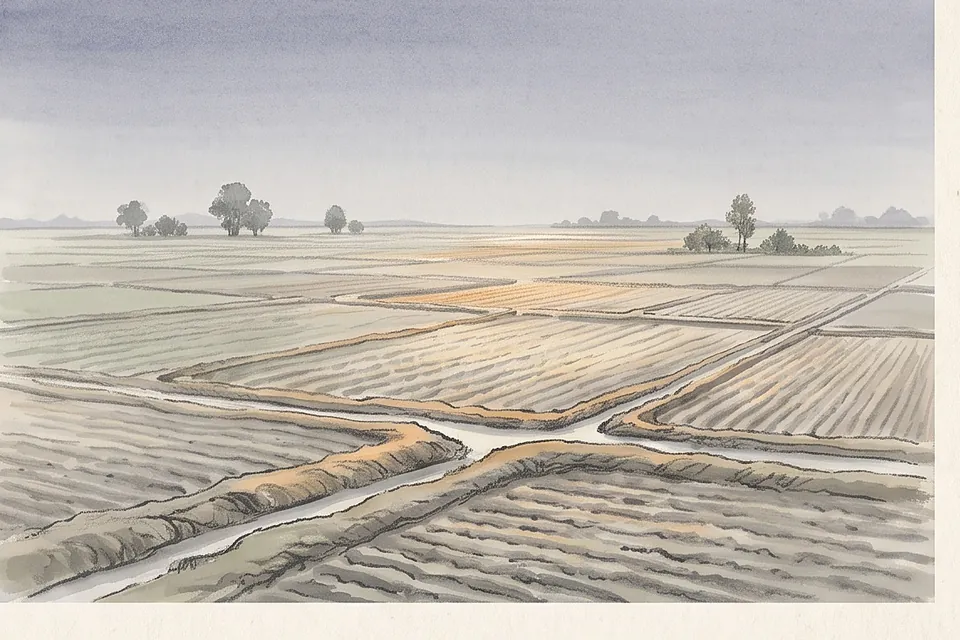
The pure yielding of earth receiving heaven's seed. A time not to lead but to carry: support, complete what others began, prepare the ground. Initiative now leads astray; following the right example leads home.
The Image
Six yielding lines — receptivity at its fullest. Strength now lies not in initiative but in the capacity to receive, carry, and complete another's design, to give form to what is already germinating. A time for the executor, the partner, the soil: support, structure, secure the rear. Loyalty to the chosen direction and a breadth able to carry everything are your chief resources.
Interpretation of hexagram 2
II. The Khwan Hexagram. names of a yang line and a yin line respectively. This explana¬ tion is now universally acquiesced in. The nomenclature of first nine, nine two, &c., or first six, six two, &c., however, is merely a jargon; and I have preferred to use, instead of it, in the translation, in order to describe the lines, the names ‘undivided’ and ‘divided.’
The lines of hexagram 2
First line
In the first line, divided, (we see its subject) treading on hoarfrost. The strong ice will come (by and by).
I. Does king Wan ascribe four attributes here to Khi&n, or only two ? According to Appendix IV, always by Chinese writers assigned to Confucius, he assigns four, corresponding to the princi¬ ples of benevolence, righteousness, propriety, and knowledge in man’s nature. Ku Hsi held that he assigned only two, and that we should translate, ‘ greatly penetrating,’ and ‘requires to be correct and firm/ two responses in divination. Up and down throughout the Text of the 64 hexagrams, we often find the characters thus coupled together. Both interpretations are possible. I have followed what is accepted as the view of Confucius. It would take pages to give a tithe of what has been written in justification of it, and to reconcile it with the other.
Second line
The second line, divided, (shows the attribute of) being straight, square, and great. (Its opera¬ tion), without repeated efforts, will be in every respect advantageous.
‘ The dragon ’ is the symbol employed by the duke of Aau to represent ‘the superior man’ and especially ‘the great man/ exhibiting the virtues or attributes characteristic of heaven. The creature’s proper home is in the water, but it can disport itself on the land, and also fly and soar aloft. It has been from the earliest time the emblem with the Chinese of the highest dignity and wis¬ dom, of sovereignty and sagehood, the combination of which con¬ stitutes ‘ the great man.’ One emblem runs through the lines of many of the hexagrams as here.
Third line
The third line, divided, (shows its subject) keeping his excellence under restraint, but firmly maintaining it. If he should have occasion to en¬ gage in the king’s service, though he will not claim the success (for himself), he will bring affairs to a good issue.
But the dragon appears in the sixth line as going beyond the proper limits. The ruling-sage has gone through all the sphere in which he is called on to display his attributes; it is time for him to relax. The line should not be always pulled tight; the bow should not be always kept drawn. The unchanging use
Fourth line
The fourth line, divided, (shows the symbol of) a sack tied up. There will be no ground for blame or for praise.
intended) has to make any movement, if he take the initiative, he will go astray; if he follow, he will find his (proper) lord. The advantageousness will be seen in his getting friends in the south-west, and losing friends in the north-east. If he rest in cor¬ rectness and firmness, there will be good fortune.
Fifth line
The fifth line, divided, (shows) the yellow lower garment. There will be great good fortune.
of force will give occasion for repentance. The moral meaning found in the line is that ‘ the high shall be abased.’
Top line
The sixth line, divided, (shows) dragons fight¬ ing in the wild. Their blood is purple and yellow.
The meaning given to the supernumerary paragraph is the opposite of that of paragraph 6. The ‘ host of dragons without their heads ’ would give us the next hexagram, or Kh wan, made up of six divided lines. Force would have given place to submission, and haughtiness to humility; and the result would be good fortune. Such at least is the interpretation of the paragraph given in a narrative of the 3 o-ATwan under b. c. 513. For further explanation of the duke of iTau’s meaning, see Appendixes II and IV.
Did hexagram 2 come up in your reading? The oracle itself gives the full reading, with changing lines and the second hexagram.
Cast the coins