Hexagram 34 · 大壯 · dà zhuàng
Hexagram 34. Dà Zhuàng · The Power of the Great
☳☰ Thunder over heaven: Zhèn above, Qián below.
T& Afwang indicates that (under the conditions which it symbolises) it will be advantageous to be firm and correct.
T& Afwang indicates that (under the conditions which it symbolises) it will be advantageous to be firm and correct.
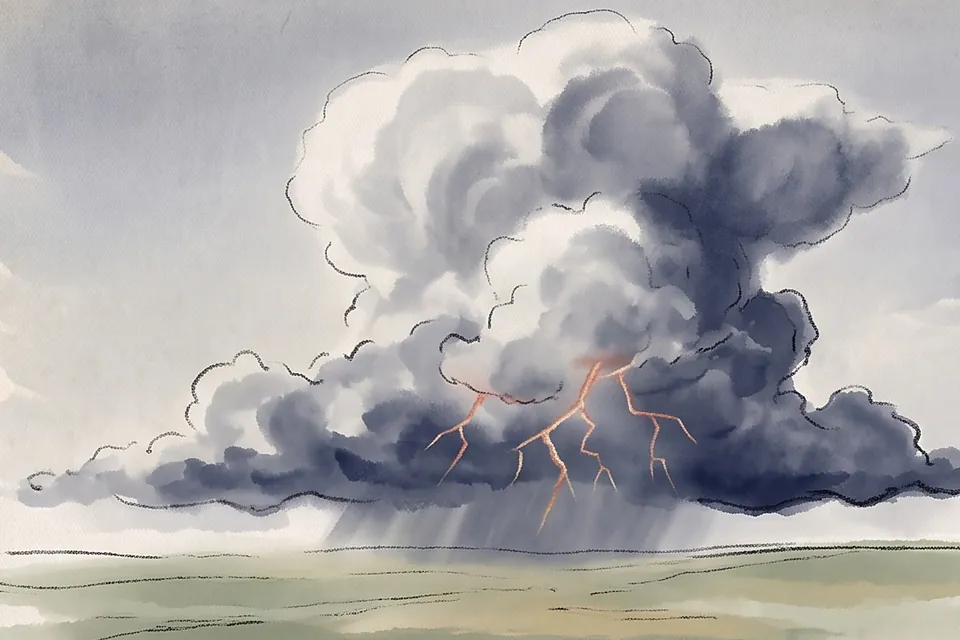
Thunder rolls in heaven itself: strength abounds, everything seems within reach. Precisely for that reason the question now is not 'is there strength enough' but 'is the cause right'. Power without rightness is a ram that breaks both the gate and its own horns. Join strength to justice, and do not force where you may pass.
The Image
Thunder rolls in heaven itself: power on the rise, everything seems within reach. The critical question has shifted: not 'is there strength enough' but 'is there the right'. Power without right is the ram breaking its horns on the fence. Drive the thrust through the gate, not into the wall: the legal and moral cleanness of the move now matters more than its energy.
Interpretation of hexagram 34
XXXIV. The Ta ATwang Hexagram. the necessity of the time requires superior men to withdraw before them.’ Yet the auspice of Thun is not all bad. By firm correct¬ ness the threatened evil may be arrested to a small extent.
The lines of hexagram 34
First line
The first line, undivided, shows its subject manifesting his strength in his toes. But advance will lead to evil,—most certainly.
‘A retiring tail’ seems to suggest the idea of the subject of the lines hurrying away, which would only aggravate the evil and danger of the time.
Second line
The second line, undivided, shows that with firm correctness there will be good fortune.
‘ His purpose ’ in line 2 is the purpose to withdraw. The weak 2 responds correctly to the strong 5, and both are central. The purpose therefore is symbolled as in the text. The ‘ yellow ’ colour of the ox is introduced because of its being ‘ correct,’ and of a piece with the central place of the line.
Third line
The third line, undivided, shows, in the case of a small man, one using all his strength; and in the case of a superior man, one whose rule is not to do so. Even with firm correctness the position would be perilous. (The exercise of strength in it might be compared to the case of) a ram butting against a fence, and getting his horns entangled.
Line 3 has no proper correlate in 6; and its subject allows himself to be entangled and impeded by the subjects of 1 and 2. He is too familiar with them, and they presume, and fetter his movements;—compare Analects, 17. 25. He should keep them at a distance.
Fourth line
The fourth line, undivided, shows (a case in which) firm correctness leads to good fortune, and occasion for repentance disappears. (We see) the fence opened without the horns being entangled. The strength is like that in the wheel-spokes of a large waggon.
Line 4 has a correlate in 1, and is free to exercise the decision belonging to its subject. The line is the first in Kh ien, symbolic of strength.
Fifth line
The fifth line, divided, shows one who loses his ram(-like strength) in the ease of his position. (But) there will be no occasion for repentance.
In the Shfi IV, v, Section 2. 9, the worthy 1 Yin is made to say, ‘ The minister will not for favour or gain continue in an office whose work is done;’ and the Khang-hsi editors refer to Lis words as an illustration of what is said on line 5. It has its correlate in 2, and its subject carries out the purpose to retire ‘ in an admirable way.’
Top line
The sixth line, divided, shows (one who may be compared to) the ram butting against the fence, and unable either to retreat, or to advance as he would fain do. There will not be advantage in any respect; but if he realise the difficulty (of his position), there will be good fortune.
Line 6 is strong, and with no correlate to detain it in 3. Its subject vigorously and happily carries out the idea of the hexagram.
Did hexagram 34 come up in your reading? The oracle itself gives the full reading, with changing lines and the second hexagram.
Cast the coins