Hexagram 59 · 渙 · huàn
Hexagram 59. Huàn · Dispersion
☴☵ Wind over water: Xùn above, Kǎn below.
HwAn intimates that (under its conditions) there will be progress and success. The king goes to his ancestral temple ; and it will be advantageous to
HwAn intimates that (under its conditions) there will be progress and success. The king goes to his ancestral temple ; and it will be advantageous to
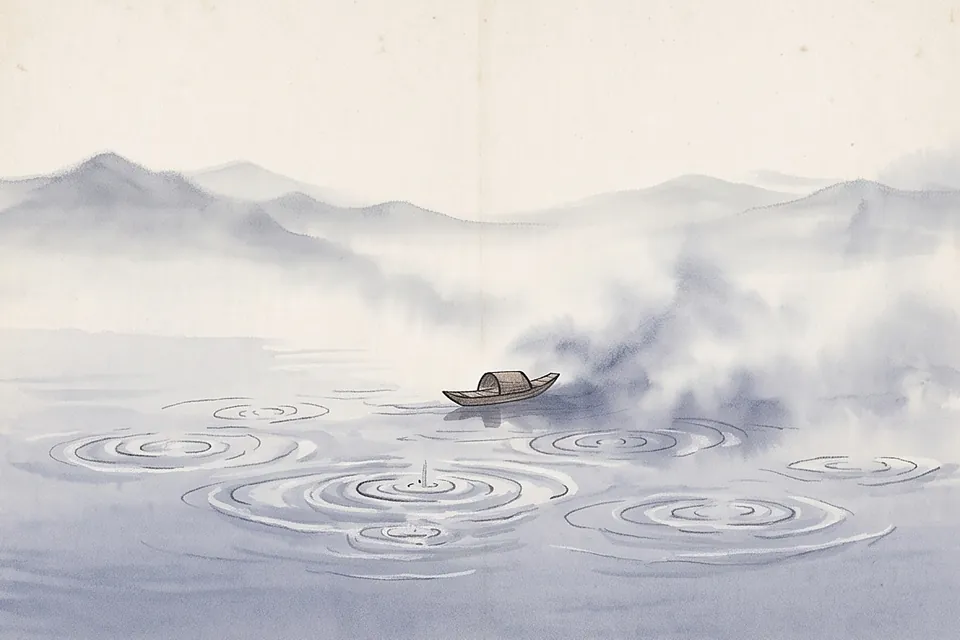
Wind drives the standing waters apart: dissolution — of rigidity, estrangement, the egotism that divides people. Melt the ice: forgive, and gather the scattered around a common shrine — an idea, a faith, a cause. When the private self yields to the common, the great crossing becomes possible.
The Image
Wind passes over the water and drives off the stagnant: everything rigid and divisive is due for dispersal — the ice of estrangement, clannishness, egotism. The tools: forgiveness, a common symbol or cause (the 'temple'), generosity, the removal of barriers. The phase's paradox: to gather people anew, one must first dissolve what divided them — including one's own coterie.
Interpretation of hexagram 59
LIX. The HwAn Hexagram. displayed in his complexion. Akin to this is the significance of the hexagram T u i representing a marsh, as denoting pleasure. Although the yin lines give it its special character they owe their power and effect to the yang; so when the qualities of mildness and harmony prevail in a 'man, without true-heartedness and in¬ tegrity to control and direct them, they will fail to be correct, and may degenerate into what is evil. Hence it is said that it will be advantageous to be firm and correct! ’
The lines of hexagram 59
First line
The first line, divided, shows its subject en¬ gaged in rescuing (from the impending evil) and having (the assistance of) a strong horse. There will be good fortune.
The feeling then of pleasure is the subject of this hexagram. The above quotation sufficiently explains the concluding characters of the Thwan; but where is the intimation in Tui of progress and attainments ? It is supposed to be in the one weak line surmount¬ ing each trigram and supported by the two strong lines. Fancy sees in that mildness and benignity energised by a double portion of strength.
Second line
The second line, undivided, shows its subject, amid the dispersion, hurrying to his contrivance (for security). All occasion for repentance will disappear.
Line i, strong in the place of strength, with no proper correlate above, is thus confined to itself. But its subject is sufficient for himself. There will be good fortune.
Third line
The third line, divided, shows its subject discarding any regard to his own person. There will be no occasion for repentance.
Line 2, by the rule of place, should be weak, but it is strong. Without any proper correlate, and contiguous to the weak 3, the subject of it might be injuriously affected, and there would be cause for repentance. But the sincerity natural in his central position counteracts all this.
Fourth line
The fourth line, divided, shows its subject scattering the (different) parties (in the state); which leads to great good fortune. From the dispersion (he collects again good men standing out, a crowd) like a mound, which is what ordinary men would not have thought of.
The view of the third paragraph that appears in the translation is derived from the Khang-hsi editors. The evil threatened in it would be a consequence of the excessive devotion of its subject to pleasure.
Fifth line
The fifth line, undivided, shows its subject amidst the dispersion issuing his great announce¬ ments as the perspiration (flows from his body).
‘ The bordering on what is injurious ’ in paragraph 4 has refer¬ ence to the contiguity of line 4 to the weak 3. That might have
Top line
The topmost line, undivided, shows its subject disposing of (what may be called) its bloody wounds, and going and separating himself from its anxious fears. There will be no error.
THE HWAN HEXAGRAM.
Did hexagram 59 come up in your reading? The oracle itself gives the full reading, with changing lines and the second hexagram.
Cast the coins