Hexagram 20 · 觀 · guān
Hexagram 20. Guān · Contemplation
☴☷ Wind over earth: Xùn above, Kūn below.
Kw 4 n shows (how he whom it represents should be like) the worshipper who has washed his hands, but not (yet) presented his offerings;—with sincerity
Kw 4 n shows (how he whom it represents should be like) the worshipper who has washed his hands, but not (yet) presented his offerings;—with sincerity
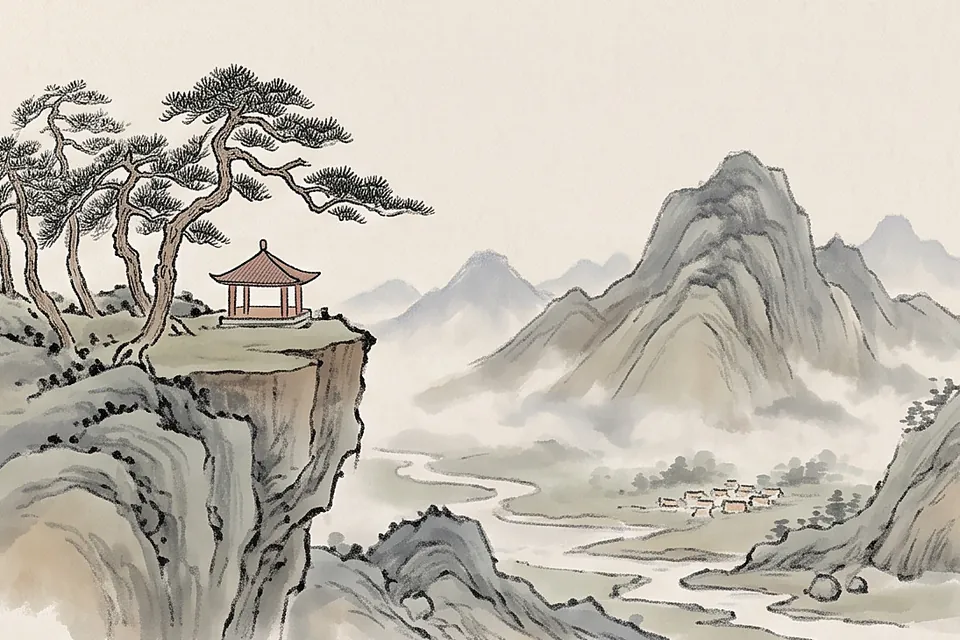
The instant between washing and sacrifice — concentrated beholding. Set action aside: what matters now is to see the whole — yourself, the people, the shape of events. The contemplator is himself in view: your gravity is what others will believe.
The Image
Wind passes over the earth, touching everything: the view from above. A pause for observation, audit, strategy: see the system whole, and yourself as part of it. Remember too: the observer is himself in sight, like a tower on a plain; your gravity and consistency now influence more than any directive.
Interpretation of hexagram 20
XX. The Kwan Hexagram. Yang, we use the phrase, “the seventh day.”’ The Khang-hs! editors say that this is the best explanation of the language of the Text that can be given:—‘The Yang numbers culminate in 9, the influence then receding and producing the 8 of the smaller Yin. The Yin numbers culminate in 6, and the next advance produces the \j of the smaller Yang; so that 7 and 8 are the numbers indicating the first birth of what is Yi n and what is Ya n g.’ ‘ If we go to seek,’ they add, ‘any other explanation of the phraseology of the Text, and such expressions as “ 3 days,” “ 3 years,” “ 10 years,” &c., we make them unintelligible.’ Lin is the hexagram of the twelfth month.
The lines of hexagram 20
First line
The first line, divided, shows the looking of a lad;—not blamable in men of inferior rank, but matter for regret in superior men.
Line r is a strong line in its proper place. The danger is that its subject may be more strong than prudent, hence the caution in requiring firm correctness.
Second line
The second line, divided, shows one peeping out from a door. It would be advantageous if it were (merely) the firm correctness of a female.
Line 2, as strong, should be in an odd place; but this is more than counterbalanced by the central position, and its correlate in line 5.
Third line
The third line, divided, shows one looking at (the course of) his own life, to advance or recede (accordingly).
Line 3 is weak, and neither central, nor in its correct position. Hence its action will not be advantageous; but being at the top of the trigram Tui, which means being pleased, its subject is repre¬ sented as ‘ well pleased to advance.’ Anxious reflection will save him from error.
Fourth line
The fourth line, divided, shows one contem¬ plating the glory of the kingdom. It will be ad¬ vantageous for him, being such as he is, (to seek) to be a guest of the king.
Line 4, though weak, is in its proper place, and has for its cor¬ relate the strong 1. Hence its advance is ‘in the highest style.’
Fifth line
The fifth line, undivided, shows its subject contemplating his own life(-course). A superior man, he will (thus) fall into no error.
Line g is the position of the ruler. It is weak, but being central, and having for its correlate the strong and central 2, we have in it a symbol of authority distrustful of itself, and employing fit agents;— characteristic of the wise ruler.
Top line
The sixth line, undivided, shows its subject contemplating his character to see if it be indeed that of a superior man. He will not fall into error.
Line 6 is the last of the trigram Khwan, the height therefore of docility. Line 2 is not its correlate, but it belongs to the Yin to seek for the Yang ; and it is so emphatically in this case. Hence the characteristic and issue as assigned.
Did hexagram 20 come up in your reading? The oracle itself gives the full reading, with changing lines and the second hexagram.
Cast the coins