Hexagram 12 · 否 · pǐ
Hexagram 12. Pǐ · Standstill
☰☷ Heaven over earth: Qián above, Kūn below.
In Phi there is the want of good understanding between the (different classes of) men, and its in¬ dication is unfavourable to the firm and correct
In Phi there is the want of good understanding between the (different classes of) men, and its in¬ dication is unfavourable to the firm and correct
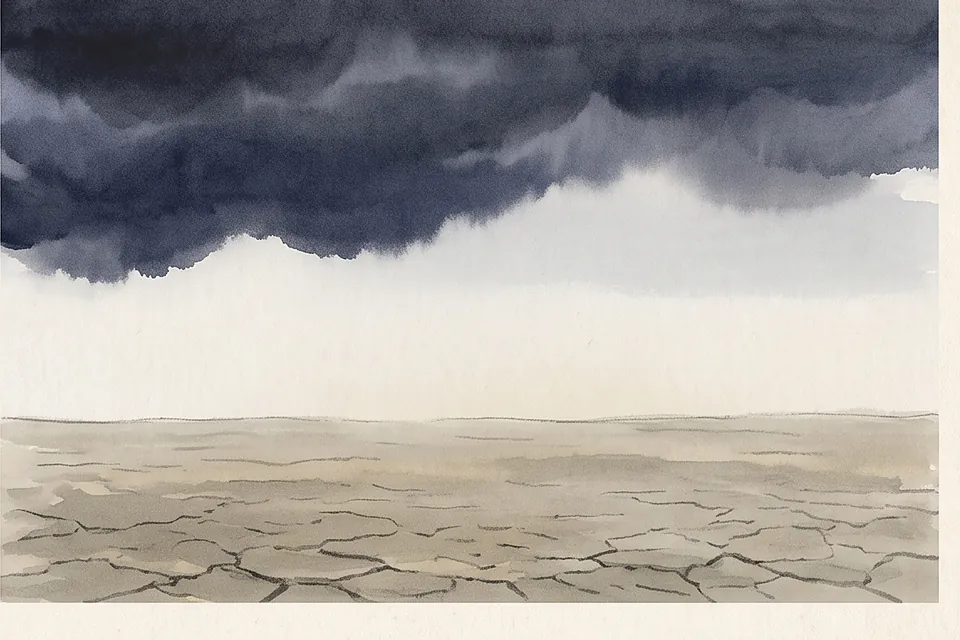
Heaven and earth are estranged; stagnation reigns and mediocrity holds power. Do not spend yourself on what cannot succeed now, and do not buy success with concessions in essentials. Withdraw inward, keep your dignity — no standstill lasts forever.
The Image
Heaven and earth have parted: channels closed, decisions bog down, mediocrity holds the posts. In this phase effort yields disproportionately little — and that is not your fault. The strategy: reduce outward activity, buy no position with concessions of principle, preserve competence and your people. Standstill is finite; the winner is the one who meets the turn unbroken.
Interpretation of hexagram 12
XII. The Put Hexagram. The symbolism of paragraph 1 is suggested by the three strong lines of iOien all together, and all possessed by the same instinct to advance. The movement of the first will be supported by that of the others, and be fortunate.
The lines of hexagram 12
First line
The first line, divided, suggests the idea of grass pulled up, and bringing with it other stalks with whose roots it is connected. With firm cor¬ rectness (on the part of its subject), there will be good fortune and progress.
The second line is strong, but in an even place. This is sup¬ posed to temper the strength of its subject; which is expressed by the first of his characteristics. But the even place is the central; and it is responded to by a proper correlate in the fifth line above. Hence come all the symbolism of the paragraph and the auspice of good fortune implied in it.
Second line
The second line, divided, shows its subject patient and obedient. To the small man (comport¬ ing himself so) there will be good fortune. If the great man (comport himself) as the distress and ob¬ struction require, he will have success.
Beneath the symbolism in paragraph 3 there lies the persuasion of the constant change that is taking place in nature and in human affairs. As night succeeds to day, and winter to summer, so calamity may be expected to follow prosperity, and decay the flourishing of a state. The third is the last of the lines of AfHen, by whose strength and activity the happy state of Thai has been produced. Another aspect of things may be looked for; but by firmness and correctness the good estate of the present may be long continued.
Third line
The third line, divided, shows its subject ashamed of the purpose folded (in his breast).
According to the treatise on the Thwan, the subjects of the fourth and other upper lines are not ‘the small returning’ as opponents of the strong lines below, as is generally supposed; but as the correlates of those lines, of one heart and mind with them to maintain the state of Thai, and giving them, humbly but readily, all the help in their power.
Fourth line
The fourth line, undivided, shows its subject acting in accordance with the ordination (of Heaven), and committing no error. His companions will come and share in his happiness.
Ti-yi, the last sovereign but one of the Yin dynasty, reigned from b. c. 1191 to 1155; but what was the history of him and his sister here referred to we do not know. P. Regis assumes that he gave his sister in marriage to the lord of A’au, known in subse-
Fifth line
In the fifth line, undivided, we see him who
course of the superior man. We see in it the great gone and the little come.
Top line
The sixth line, undivided, shows the overthrow (and removal of) the condition of distress and ob¬ struction. Before this there was that condition. Hereafter there will be joy.
quent time as king Wan, and that she was the famous Thai-sze;— contrary to all the evidence I have been able to find on the subject. According to .Oang-gze, Ti-yi was the first to enact a law that daughters of the royal house, in marrying princes of the states, should be in subjection to them, as if they were not superior to them in rank. Here line 5, while occupying the place of dignity and au¬ thority in the hexagram, is yet a weak line in the place of a strong one; and its subject, accordingly, humbly condescends to his strong and proper correlate in line 2.
Did hexagram 12 come up in your reading? The oracle itself gives the full reading, with changing lines and the second hexagram.
Cast the coins