Hexagram 10 · 履 · lǚ
Hexagram 10. Lǚ · Treading
☰☱ Heaven over lake: Qián above, Duì below.
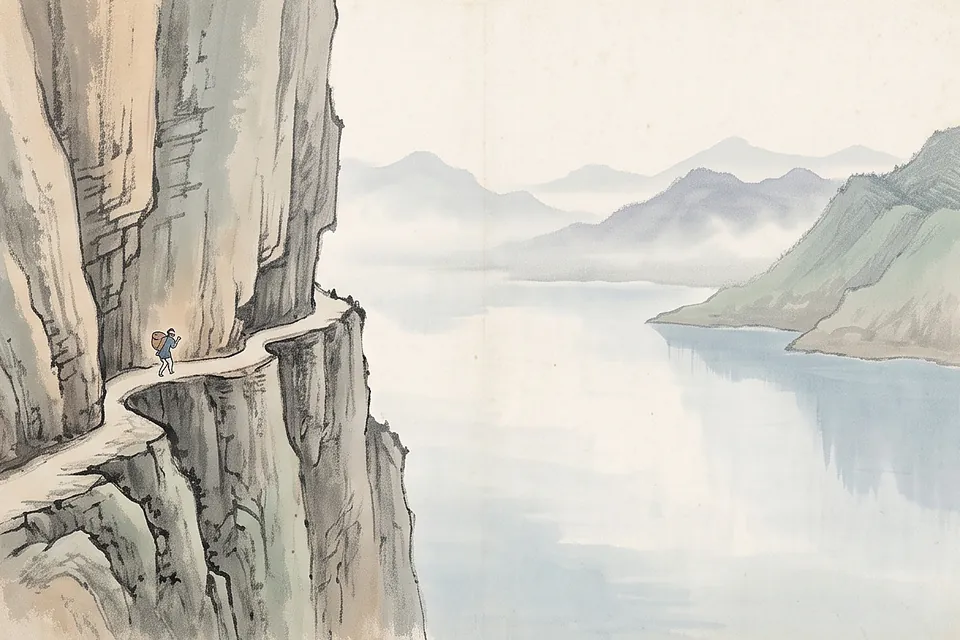
(Li suggests the idea of) one treading on the tail of a tiger, which does not bite him. There will be progress and success.
(Li suggests the idea of) one treading on the tail of a tiger, which does not bite him. There will be progress and success.
You must walk beside a dangerous power — a superior, circumstances, an elemental force. It can be done if every step is impeccable: courteous, precise, knowing your place without servility. Tact and inner dignity will carry you where audacity would destroy.
The Image
The lake beneath heaven: the weak walks behind the strong and stays whole while it keeps tact. You act beside a power that could crush — a superior, a competitor, the market's element. Success depends not on daring but on the quality of the step: precision, courtesy, a sense of distance. Dignity without insolence — the gait at which the tiger does not bite.
Interpretation of hexagram 10
X. The Li Hexagram. kingdom of Yin or Shang, the China of the twelfth century b. c., the era of king Wan. Rain coming and moistening the ground is the cause of the beauty and luxuriance of the vegetable world, and the emblem of the blessings flowing from good training and good government. Here therefore in the west, the hereditary territory of the house of Wau, are blessings which might enrich the whole kingdom ; but they are somehow restrained. The dense clouds do not empty their stores.
The lines of hexagram 10
First line
The first line, undivided, shows its subject treading his accustomed path. If he go forward, there will be no error.
P. Regis says:—‘ To declare openly that no rain fell from the heavens long covered with dense clouds over the great tract of country, which stretched from the western border to the court and on to the eastern sea, was nothing else but leaving it to all thought¬ ful minds to draw the conclusion that the family of Wan was as worthy of the supreme seat as that of Shau, the tyrant, however ancient, was unworthy of it (vol. i, p. 356).’ The intimation is not put in the Text, however, so clearly as by P. Regis.
Second line
The second line, undivided, shows its subject treading the path that is level and easy;—a quiet and solitary man, to whom, if he be firm and correct, there will be good fortune.
Line 1 is undivided, the first line of Khien, occupying its proper place. Its subject, therefore, notwithstanding the check of line 4, resumes his movement, and will act according to his strong nature, and go forward.
Third line
The third line, divided, shows a one-eyed man (who thinks he) can see; a lame man (who thinks he) can walk well; one who treads on the tail of a tiger and is bitten. (All this indicates) ill fortune. We have a (mere) bravo acting the part of a great ruler.
Line 2 is also strong, and though an even place is not appropriate to it, that place being central, its subject will make common cause with the subject of line r; and there will be good fortune.
Fourth line
The fourth line, undivided, shows its subject treading on the tail of a tiger. He becomes full of apprehensive caution, and in the end there will be good fortune.
Line 3, though strong, and in a proper place, yet not being in the centre, is supposed to be less able to resist the restraint of line 4; and hence it has the ill omens that are given.
Fifth line
The fifth line, undivided, shows the resolute tread of its subject. Though he be firm and correct, there will be peril.
The subject of line 4, one weak line against all the strong lines of the hexagram, might well expect wounds, and feel apprehension in trying to restrain the others; but it is in its proper place; it is the first line also of Sun, whose attribute is docile flexibility.
Top line
The sixth line, undivided, tells us to look at (the whole course) that is trodden, and examine the
THE 1.1 HEXAGRAM.
Did hexagram 10 come up in your reading? The oracle itself gives the full reading, with changing lines and the second hexagram.
Cast the coins