Hexagram 50 · 鼎 · dǐng
Hexagram 50. Dǐng · The Cauldron
☲☴ Fire over wind: Lí above, Xùn below.
Ting gives the intimation of great progress and success.
Ting gives the intimation of great progress and success.
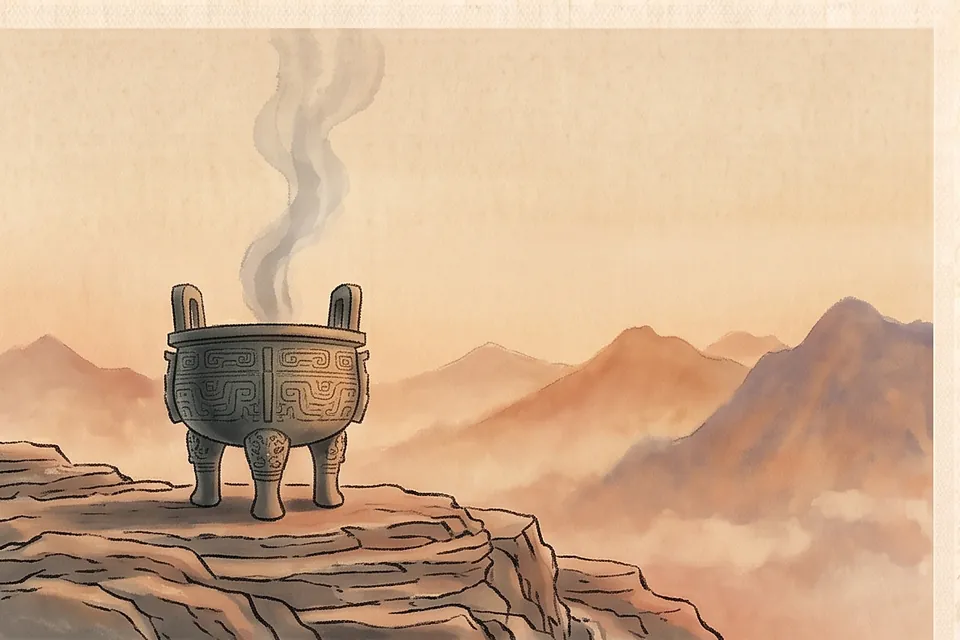
After the breaking of the old — the casting of a new vessel. The cauldron stands firm and turns the raw into nourishment for both men and spirits: a time to consolidate what is won, to build form, culture, order. Set everything on solid legs, and see that the vessel serves the common good, not one alone.
The Image
Fire above wood: flame beneath the sacrificial vessel. After the breaking of the old comes the time to cast the new: institutions, rules, culture, order. The cauldron stands on three legs — check yours: meaning, people, resource. And remember the vessel's purpose: to turn the raw into nourishment. Whatever you now build must feed someone — otherwise it is an ornament, not a cauldron.
Interpretation of hexagram 50
L. The Ting Hexagram. given as to the spirit and manner in which they should be brought about.
The lines of hexagram 50
First line
The first line, divided, shows the caldron over¬ thrown and its feet turned up. (But) there will be
For the way in which the notion of change is brought out of the trigrams of the figure, see Appendixes I and II. It is assumed in the Thwan that change is viewed by people generally with suspicion and dislike, and should not be made hastily. When made as a necessity, and its good effects appear, the issues will be great and good. A proved necessity for them beforehand; and a firm correctness in the conduct of them :—these are the conditions by which changes should be regulated.
Second line
The second line, undivided, shows the caldron with the things (to be cooked) in it. (If its subject can say), ‘ My enemy dislikes me, but he cannot approach me,’ there will be good fortune.
Line 1, at the bottom of the figure, may be taken as denoting change made at too early a period. It has no proper correlate or helper, moreover, above. Hence its subject is represented as tied up, unable to take any action.
Third line
The third line, undivided, shows the caldron with (the places of) its ears changed. The progress (of its subject) is (thus) stopped. The fat flesh of the pheasant (which is in the caldron) will not be eaten. But the (genial) rain will come, and the grounds for repentance will disappear. There will be good fortune in the end.
Line 2, though weak, is in its correct place. It is in the centre also of the trigram Lt, signifying brightness and intelligence, and has a proper correlate in the strong 5. Let its subject take action in the way of change.
Fourth line
The fourth line, undivided, shows the caldron with its feet broken; and its contents, designed for the ruler’s use, overturned and spilt. Its subject will be made to blush for shame. There will be evil.
The symbolism of paragraph 3 is twofold. The line is strong, and in the correct position, but it has passed the centre of Sun and is on its outward verge. These conditions may dispose its subject to reckless and violent changing which would be bad. But if he act cautiously and with due deliberation, he may take action, and he will be believed in.
Fifth line
The fifth line, divided, shows the caldron with yellow ears and rings of metal in them. There will be advantage through being firm and correct.
Line 4 is strong, but in the place of a weak line. This might vitiate any action of its subject in the way of change, and give occasion for repentance. But other conditions are intimated that
Top line
The sixth line, undivided, shows the caldron with rings of jade. There will be great good for¬ tune, and all action taken will be in every way advantageous.
advantage in its getting rid of what was bad in it. (Or it shows us) the concubine (whose position is improved) by means of her son. There will be no error.
Did hexagram 50 come up in your reading? The oracle itself gives the full reading, with changing lines and the second hexagram.
Cast the coins